by
Donald Prothero, May 07 2014
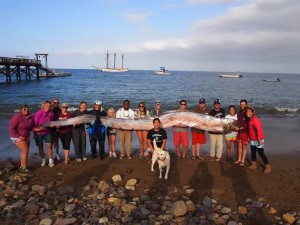
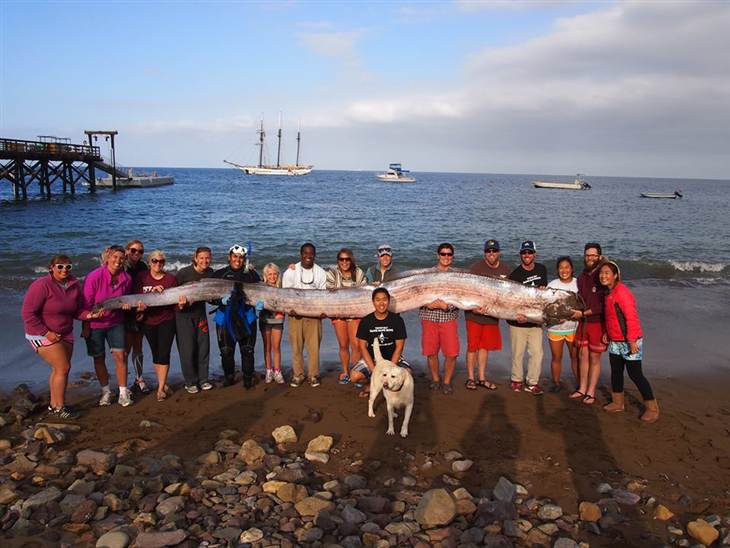
The 18-foot oarfish that was stranded on the beaches of Catalina Island on Oct. 13, 2013.
Last fall, there was a big buzz across the internet when two rare events happened just five days apart: the stranding of two dead oarfish on southern California beaches. On Oct. 13, an 18-footer was found on Catalina Island, and on Oct. 18, a 14-footer was found on the beach in Oceanside. The oarfish is an amazing-looking sea creature, with a long, flat, serpentine body, a long dorsal fin along the entire length of its body, and tiny spine-like pectoral and pelvic fins. It is thought to have been the source of some of the “sea serpent” legends, since large specimens can be up to 50 feet (15 m) long. The fact that two such strandings had happened so closely in time generated most of the buzz, since strandings are normally rare, with one or two a year at most. Once in awhile there are accidental sightings of oarfish which are apparently trying to beach themselves, such as shown in this remarkable footage.
The biggest buzz, however, was not about the unusual occurrence of two strandings in five days, but about some Japanese legend that claims that oarfish strandings predict earthquakes. This ridiculous idea managed to get coverage on a wide variety of news sites and websites, including the BBC, with almost no mention of any scientist debunking it. As usual, the credulous media ran with the story for days and not once did you hear the slightest bit of skepticism (except maybe a passing sentence or two from some biologist or geologist). Continue reading…
comments (6)
by
Daniel Loxton, Jan 07 2014
Have you heard that Bigfooters finally have the proof we’ve been waiting for? At long last, after half a century of hunting, they have finally gotten their hands on a really seriously genuine Bigfoot body—again! And by astonishing coincidence, this totally completely real Bigfoot body is being offered up to the media by one of the exact same guys who gave us the previous totally real “Georgia Bigfoot” body, way back in the storied yesteryear of 2008. That case was a hoax. As the hoaxers explained, the 2008 “body” was really a costume stuffed with roadkill.
“It’s just a big hoax, a big joke,” said car salesman Rick Dyer. Dyer told Channel 2 he never intended to put it across as the real deal. “It’s bigfoot. Bigfoot doesn’t exist,” he said.
Now that same hoaxer is now back, making headlines with the claim that he shot and killed another Bigfoot. “I’m going to go down in history as the best Bigfoot tracker in the world,” he boasts�—and for some reason we’re talking about it.
Make no mistake, there is a disreputable basement level to Bigfootery, and this is it. I said as much when my Abominable Science! co-author Don Prothero wrote to me a couple of days ago to ask if we should put up a post about it. “It’s really the lowest end of Bigfoot beeswax,” I replied. “I kinda hate to publicize it. I don’t think I’ll bother writing it up at this point.”
Thing is, I’m fond of cryptozoology. I’m really only interested in dealing with the better cases and the more serious practitioners. I think cryptozoologists are mistaken, but that does not mean that I want cryptozoology presented as a complete circus. To that end, for example, I made a conscious choice years ago not to record and use the many interpersonal feuds and slurs that Bigfooters hurl at each other, even though they’ve cooked up some real humdingers. It’s not my job to make monster-hunters appear ridiculous, but to attempt in good faith to find out what’s true. Continue reading…
comments (5)
by
Donald Prothero, Dec 04 2013
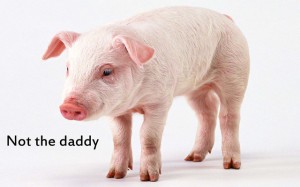
Our ancestor? Not likely…
This past week I’ve been getting all sorts of questions from people about the strange study just reported in the British tabloid
The Daily Mail. Some scientist in Georgia claims that humans are formed by hybridizing apes and pigs. At first, I thought it was a hoax or some outrageous parody or Poe, or possibly an example of the media distorting the original results beyond all recognition, because it’s so crazy that it’s hard to imagine any legitimate scientist making that claim. But a little digging shows it’s not a hoax or parody: there
is a crackpot scientist out there who had made the claim, and naturally the media loved it and published it without any fact-checking (as usual).
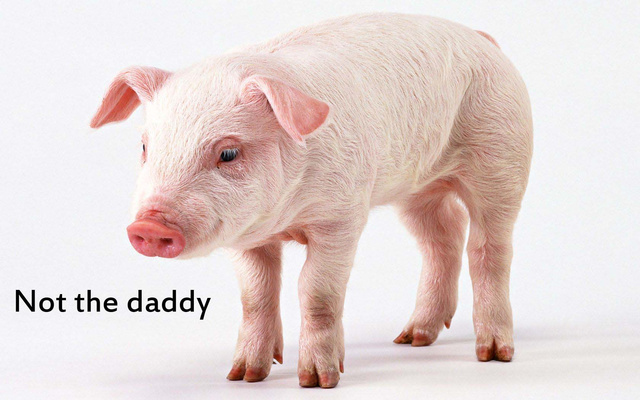
First, the assertion: a Georgia geneticist, Dr. Eugene McCarthy (a sad coincidence that he has the same name as the groundbreaking anti-Vietnam War presidential candidate in 1968) claims that humans have evolved by hybridization between a boar and a female chimpanzee. Anyone trained in genetics or evolution will immediately do a double-take reading this, because it so far off the edge of crazy that it cries out to be examined further. So you click on the link, and what do you find? Is there a ton of genetic data, peer-reviewed and published in a respectable journal, that would allow us to take the claim seriously? No, not even close. Not only is it a wild claim made on a personal website without any peer review (the classic sign of crackpot science), but the evidence is not genetic at all, even though the author claims to be a legitimate geneticist! Once you go to the original link, you find that it’s a list of superficial fleshy similarities between the soft tissues of pigs and humans: naked skin, thick skin, sweating, protruding cartilaginous nose, eyebrows, heavy eyelashes, short thick upper lip, earlobes, and a long list of minor similarities in the skeleton and rest of the anatomy. Anyone who is a vertebrate anatomist familiar with phylogenetics will immediately notice that these are highly correlated characters that all occur together when a a lineage becomes less hairy, or else they are symplesiomorphic features shared by most placental mammals. What the list doesn’t point out is all the huge and fundamental differences in the skeleton he doesn’t mention, especially the unique “cloven-hoofed” even-toed hands and feet of pigs with the “double-pulley” astragalus bone, which unites them with all other artiodactyls (the “even-toed” hoofed mammals), a feature seen in no primate or any other organism on earth; and the huge differences in the skull, braincase and ear region that allow any competent anatomist to immediately distinguish a pig from any primate. Once again, it’s a classic case of someone not trained in a given field (anatomy and phylogenetics) dabbling in someone else’s orchard, cherry-picking data he doesn’t understand, and ignoring everything that flatly contradicts his ideas. Surprisingly, the one thing I would expect him to list—the low-cusped bunodont dentition of pigs and primates—isn’t mentioned (again, it’s convergent evolution since pigs and many primates have an omnivorous diet, as do bears and peccaries, who also convergently evolve bunodonty). As P.Z. Myers pointed out (he calls it the “MFAP hypothesis”, “monkey fucked a pig”), it’s very similar to the long-discredited “aquatic ape” theory of Elaine Morgan—cherry-pick a handful of superficial anatomical characters associated with loss of body hair in apes and tell a just-so story, ignoring all the rest of the evidence. Continue reading…
comments (10)
by
Donald Prothero, Nov 06 2013
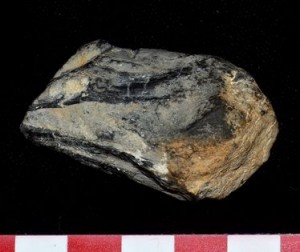
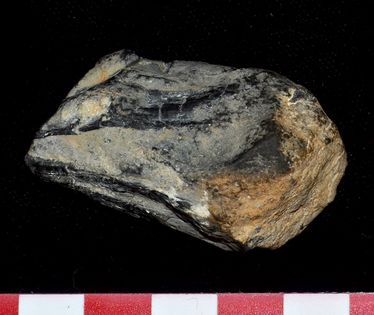
The alleged “fossil kraken beak” touted by McMenamin as the beak of the giant kraken responsible for arranging ichthyosaur bones into art. The scale is in centimeters, so it is only 5 cm long, too small to belong to any giant squid. In addition, the preservation and other details of the specimen do not resemble a cephalopod beak but some other rock or concretion.
Readers of this blog might remember a post two years ago, when I reported on the notorious crackpot paleontologist Mark McMenamin, and his claim that the ichthyosaur skeletons at Berlin-Ichthyosaur State Park in southwest Nevada were artistically arranged by some sort of huge “Kraken” squid. As I detailed in my post, the claim was laughably incompetent and ridiculous. McMenamin claimed that the arrangement of the vertebrae appeared to be deliberate, an arrangement satisfying the “artistic sense” of the giant squid. Clearly he does not know enough about the decay processes of vertebrate skeletons, which frequently leave the vertebral centra either lined up, or toppled over in rows just like we see in the Nevada ichthyosaurs. I vividly remember the buzz at the Geological Society of America (GSA) meeting in 2011, where McMenamin gave his presentation and people were openly laughing at its totally ridiculous claims—or not sure whether they were unwittingly part of an episode of “Punked” and Ashton Kutcher was going to pop out any moment. We all figured it was just another crazy idea by a notorious fringe scientist, and wrote it off to carelessness on the part of the committee that programmed the abstracts (they don’t really have the option of reviewing or rejecting them unless the abstract violates the basic formatting guidelines). The only sad consequence of this whole sordid episode is that the press and internet jumped all over this half-baked story, giving it all sorts of unwarranted coverage. As usual, the media don’t know (or don’t care) that meeting abstracts are unreviewed. They should not be given a lot of press coverage until they are peer reviewed and published. But in this age of 24/7 media coverage of junk, any sensational claim will make the news without any review or background checking or fact checking whatsoever—so McMenamin got his 15 minutes of fame for spewing junk science. Continue reading…
comments (3)
by
Donald Prothero, Jul 24 2013
The rumor mill had been buzzing for days. Then last week, as many of us were at The Amazing Meeting in Las Vegas, it was confirmed: former Playboy Playmate, has-been actor, and anti-vaxx leader Jenny McCarthy will join the cast of “The View” this fall. A number of Amazing Meeting speakers commented on it. The media were full of statements of shock and anger, not only from the prominent skeptics and bloggers like Phil Plait and Sharon Hill, but even from the mainstream media, who uniformly saw this as a bad move. The ABC network released a lame statement from “The View” founder Barbara Walters, “Jenny brings us intelligence as well as warmth and humor. She can be serious and outrageous. She has connected with our audience and offers a fresh point of view.”
I’ve seen McCarthy’s previous TV and movie appearances, and the best that can be said for them was they were outrageous. Whether her past efforts demonstrate “intelligence,” “humor,” and “seriousness” is debatable. Most people found her humor (especially in her disastrous movie “Dirty Love”, often ranked as one of the worst movies ever made) stupid, lowbrow and gross. None of her TV efforts showed she was any more intelligent than any other Hollywood celeb who is promoted for their good looks. Over the last 8 years, she has been the principal spokesperson for the anti-vaxxer movement, lending her celebrity (and that of her once-boyfriend, Jim Carrey) to spread and legitimize her deadly ideas. She is such a symbol of the movement that one of the leading sites criticizing her is called “JennyMcCarthyBodyCount.com” and keeps a constant tally of the number of unnecessary deaths and illnesses caused by the anti-vaxxers. Continue reading…
comments (19)
by
Brian Dunning, May 31 2012
 In February of this year, there was another round of media sensationalism when it was reported that a number of popular brands of lipstick contain potentially dangerous levels of lead. This is not a new claim; it has popped up a number of times, including during the 1990s and again in 2007.
It is, of course, true that many lipsticks do contain lead. It’s an effective component of some color additives, and is used at levels that are well below safety margins. Most mainstream media reported this accurately, such as this article from the Washington Post, but gave a voice to self-described watchdog groups such as the Campaign for Safe Cosmetics who put out this report claiming that there is “no safe level of lead exposure” and mischaracterizing the lead content in lipstick as “contamination”. Some alternative media and chain emails even got the science more wrong than that, stating that the lead is a cancer risk. (The practical danger from lead poisoning is as a neurotoxin, not a carcinogen.) Snopes effectively debunked those reports. Continue reading…
comments (36)
by
Donald Prothero, Nov 02 2011
Even before the annual meeting of the Geological Society of America (GSA) in Minneapolis started on October 9, there was a huge buzz among my colleagues about this remarkable abstract that claimed evidence of a giant squid, or “Kraken”, that had arranged the bones of the whale-sized ichthyosaurs (marine reptiles shaped like dolphins) from Berlin-Ichthyosaur State Park in Nevada. There was a post on the October 10 page of Pharyngula.org, and also one on Brian Switek’s Laelaps blog, “The Giant Prehistoric Squid that Ate Common Sense”. The only things geologists and paleontologists could evaluate was a short abstract, but it made such a sensational claim that the press was buzzing and the story was all over the internet.
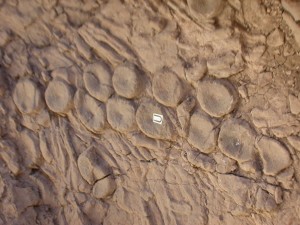
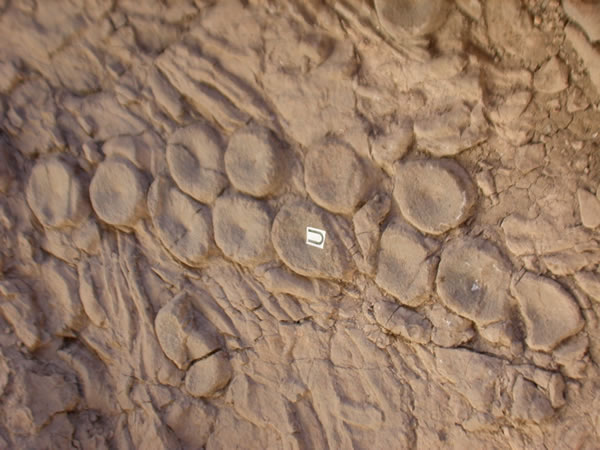
Image of the ichthyosaur bones, showing the "alignment" of the disk-shaped vertebral centra that are alleged evidence of cephalopods arranging the bones.
Based on the abstract and the GSA press release, the argument seemed to be absurd. The only positive evidence presented before the talk occurred was the claim that the bones were arranged in a pattern that resembled the alternating pattern of suckers on the arm of a giant squid. No actual physical evidence of the squid itself—no soft parts, no tentacle hooks, not even the hard “pen” that holds up the back of the animal, or its horny beak. The only “evidence” given in the press release was the alternating pattern of the vertebral centra (the large disk-shaped bones in the photograph). According to the author, this was evidence of a conscious effort on the part of a large cephalopod to “arrange” them that way! There was no mention of the possibility that any string of disks connected in the vertebral column would settle in that pattern once the tissues rotted and fell away from the backbone. No suggestion that the entire premise of the talk was just speculation based on a “pattern” of bone distribution, or “seeing patterns” where there are none, known as pareidolia (such as seeing the Virgin Mary in a grilled cheese sandwich, or reading “patterns” in tea leaves and clouds). PZ Myers of Pharyngula.org immediately got very suspicious, as did Brian Switek, and so everyone was itching to find out if there was more to this story than just a press release. Continue reading…
comments (9)
by
Donald Prothero, Jul 06 2011
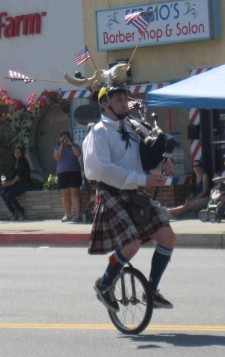
On Monday, my family and I attended the annual Fourth of July Parade in Sunland-Tujunga, California. We go nearly every year, and most years they have virtually the same lineup: lots of classic antique cars and hot rods and ATVs and motorcycles, plus flatbed trailers and marchers from church groups, anti-abortion groups, Boy Scouts, Cub Scouts, and Girl Scouts, the local Lions, Kiwanis, and other social clubs, horses from the upscale Shadow Hills neighborhood (where movie stars with horses, like Patrick Swayze, lived), fire trucks (including a lot of antique fire trucks and ambulances that come from a company in Sun Valley that supplies them for movie shoots), minor movie stars, TV actors, and local officials—and a small portion of the local high school band (because they’re out of school and mostly out of town by mid-summer).
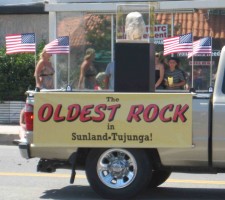
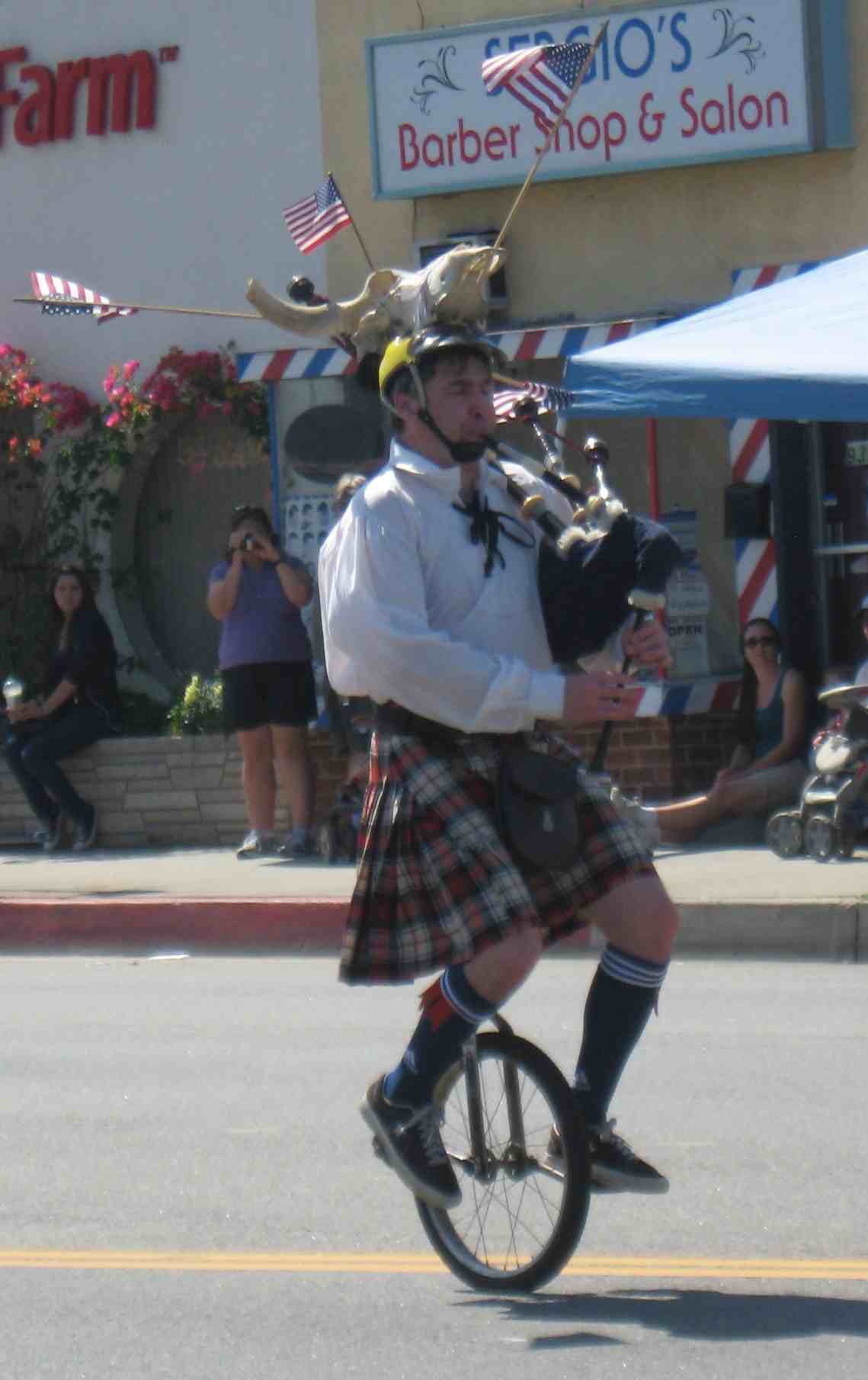
This is not your typical small town Fourth of July parade, because Sunland-Tujunga is not your typical small town. Once a foothill retreat from the city with lots of “mountain cabins”, it is one of the last Anglo enclaves in the City of Los Angeles. Long ago it was settled mostly by former hippies and bikers, so it is “redneck-NASCAR” heaven (mostly lower-middle class whites). Nearly all of the rest of the City of Los Angeles (and its school district) is largely Latino and African-American now. The parade is very casually organized, and almost anyone can march if they want to. Often, it drags on for more than an hour with large gaps between units, because there isn’t much control over the marchers (except for LAPD putting traffic barricades along the parade route). It is very different from the Rose Parade on New Year’s Day in nearby Pasadena, which is a highly professional, tightly run, multi-million-dollar enterprise with floats that cost more than most houses, and worldwide TV coverage. By contrast, the Sunland-Tujunga parade’s “floats” were mostly flatbed trucks with simple decorations, or old hay wagons pulled by tractors. There were a few changes from previous years: the parade was not led off by the LAPD motorcycle drill team (must be the budget cuts), but instead by a guy wearing a kilt and a cow-skull bike helmet ornamented with flags playing bagpipes on a unicycle. Then there was first for any parade I’ve seen: a float (actually a pickup truck) displaying the “oldest rock in Sunland-Tujunga”—although even from the sidewalk I could tell it was Mt. Lowe Granodiorite (220 m.y. old), not the actual oldest rocks in our local mountains, the Mendenhall Gneiss (1.7 billion years old)(check out the video link above—they actually did a very clever parody of geology, and the rock has its own Facebook page). There were very few local politicians (Congress is still back in D.C. fighting over the budget and the debt ceiling, so they can’t come home). And it was not nearly as political as in previous years, with only a few cars and people touting the local GOP club.
Continue reading…
comments (21)
by
Donald Prothero, Jun 08 2011
It was just one of those silly “fluff” stories they put on CNN to fill up the hours between commercials and bits of real news. The anchors were reporting on a study that surveyed the most common CEO names. With straight faces, they reported that the most common men’s CEO names were short single-syllable, mostly four-letter names like Jack, Fred, Bill, Peter, Bob, and Bruce. The most common women’s CEO names were Deborah, Debra, Sally, Cynthia, and Carolyn. Their tiny bit of “analysis” of this undigested factoid by an “onomastics specialist” (a scholar who specializes in names) was that “shortened versions of given names are often used to denote a sense of friendliness and openness. Female CEOs, on the other hand, use their full name to project a more professional image.” And, like most other stories on Headline News, CNN, USA Today, and other media which consist of no more than a few sentences of information and some superficial comment or analysis, that was it. No further discussion about why those names tend to be most common among CEOs.
It was such a jaw-droppingly stupid piece of tabloid journalism that I was intrigued to look it up and see what was really behind the story. But the story on the Linked-In site is not much longer or detailed than the reporting on CNN. Many other media on the web picked up the same story and gave it the same superficial level of discussion. All the site did was a simple analysis of correlations between occupations and first names, based on their data set of Linked-In members of professionals who join the site for networking purposes (which skews the result right there—it’s not based on a random sample of names from census data or any large, rigorously collected data set). But is it true, as they imply, that the name that parents give their child somehow determines what kind of profession they might enter? Does a decision most parents make before we are born lock us into certain types of jobs? Are we fated, like the boy named Sue in the Johnny Cash song, to follow a certain path because a parental choices?
Continue reading…
comments (17)
by
Kirsten Sanford, Aug 28 2009
This Sunday before game-time you might want to set your Tivos to record Dateline. This week, supposedly, Matt Lauer interviews Dr. Andrew Wakefield and several other affiliates of the Thoughtful House Center for Children, along with Dr. Paul Offit and journalist Brian Deer.
The Thoughtful House agreed to the interviews because they figured they would get fair treatment from the likes of Matt. I’m interested to see what kind of a program NBC has put together on this very sensitive subject.
Depending on how this major media outlet writes the script, it could either be a major affirmation of what many within the science community already know, or it could increase the divide between anti-vax’ers and science.
Please, Matt… don’t go Jenny McCarthy on us. Don’t do the usual journalistic job of being “fair-and-balanced”. This is not a “he said, she said” issue. This is science. Do tell the world what the science supports.
comments (179)