by
Donald Prothero, Mar 26 2014

The “Creation Museum” in Petersburg, Kentucky, ironically built upon rocks which disprove Noah’s flood
A foolish man, which built his house upon the sand—Matthew 7: 24-27.
Speak to the earth and it shall teach thee—Job 12:8
During the Ham on Nye debate last February 4, Bill led off with a great example to throw Ken off balance. He pointed out that (ironically), the Creation “Museum” itself was built upon rocks which refuted flood geology! Bill even brought a piece of fossiliferous limestone from a road cut nearby to show that it was full of fossils, delicately preserved, and not the kind of thing a flood would produce. He explained it briefly, but I don’t know how many people got the point—and given the humorless nature of most creationists who don’t catch on to sarcasm and snark, I doubt they even noticed the irony that their entire model was refuted by the rocks beneath them at that very place.
Let’s look at the geologic background to this concept. First of all, how do limestones form? Geologists know from studying them all over the world, and looking closely at them in ancient settings, that limestones are produced by the accumulation of fragments of calcareous animals and plants (shell fragments, corals, pieces of calcareous algae) in warm, shallow, clear tropical waters, with no mud or sand from land that would clog the gills of the shelly organisms or corals, or make the water dark and muddy. Since many of these organisms (especially corals) only form big reefs in warm tropical waters, and since much of the reef community is plants (not only the calcareous algae, but also the algae symbiotically living in reef coral polyps), the water must be very shallow and clear to allow light penetration. Consequently, modern limestones are formed in shallow clear tropical waters far from the mud of land-based rivers: the Bahamas, Bermuda, Yucatan, the Atlantic Coast of Florida (but not the Gulf side, where Mississippi mud darkens the waters), the Persian Gulf, and the southwest Pacific and Great Barrier Reef of Australia. Nowhere else! Not only is this a very restricted setting, but under no circumstances do limestones (today or in the past) show any evidence of being formed in the muddy, turbulent, cold waters of a typical flood—or even a supernatural flood. If you look at them closely, they are accumulations of layer after layer of fossil communities, slowly building on top of each other in quiet waters, often with delicate organisms (such as the stick-like bryozoans and delicate corals and sponges) buried in life position, with no evidence that they had been battered and toppled by the powerful energy of flood waters. Knowing this, right away we can refute “flood geology”, because there are many places in the world with huge piles of limestone, each made of layer upon layer of delicate fossils, that cannot be made by flood energy. Heck, even the creationists’ favorite example, the Grand Canyon, is built with many limestone layers: the Muav Limestone near the base, the huge thickness of Redwall Limestone at the cliff break, and the Kaibab and Toroweap Limestones that cap the rim. Continue reading…
comments (32)
by
Donald Prothero, Mar 07 2012
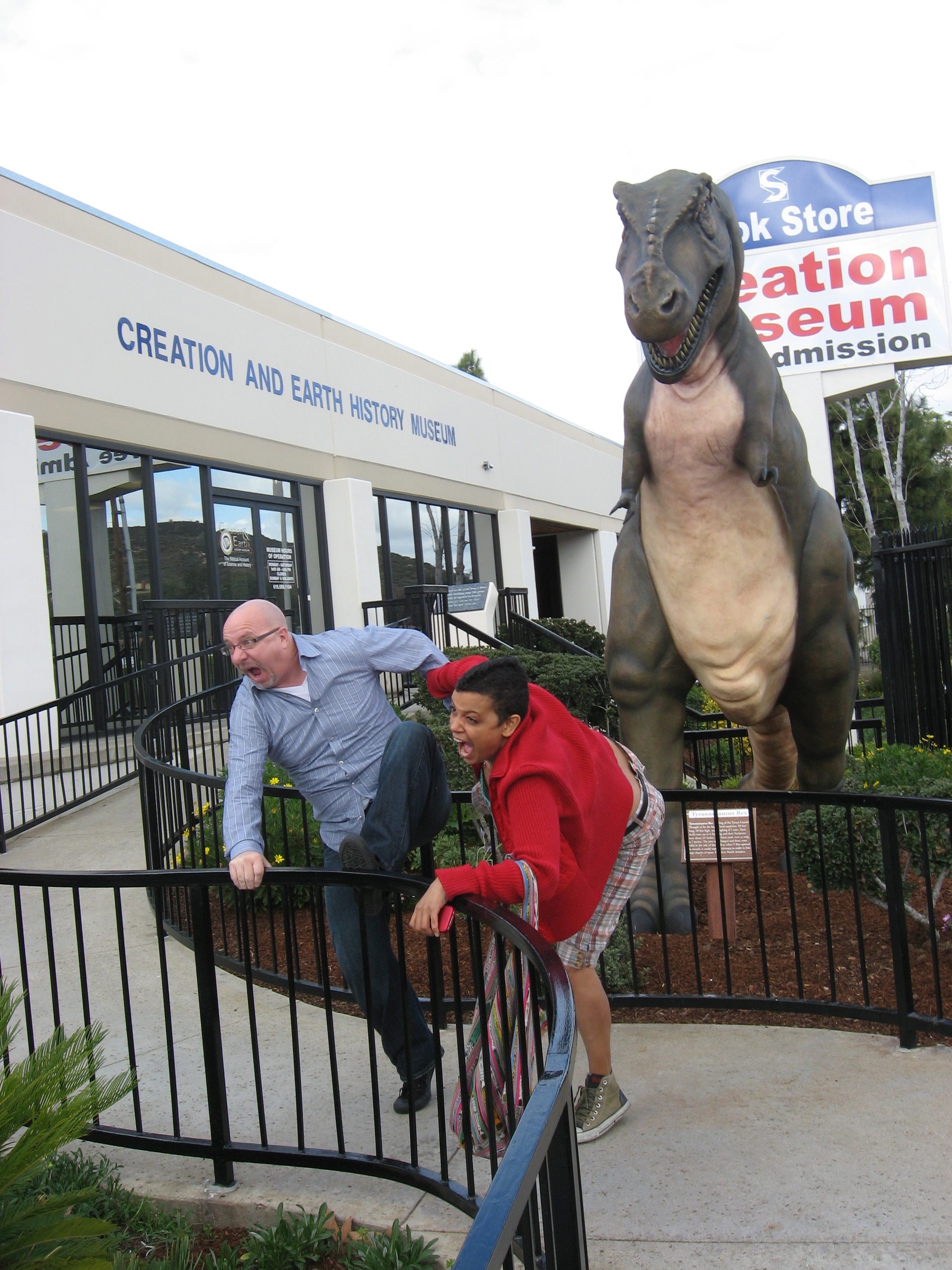
Last Feb. 11, the day before Darwin’s 203rd Birthday, I was invited by Ross Blocher and Carrie Poppy of the “Oh, no, it’s Ross and Carrie” podcast to accompany them, along with Emery Emery and Heather Henderson of the Ardent Atheist podcast, to visit the Creation Museum in Santee, east of San Diego, California (videoblog available here). This museum was originally built by the Institute of Creation “Research” (ICR), once led by the late Henry Morris and Duane Gish, which has since relocated to Texas. At one time ICR was the leading creationist organization in the U.S., but lately they seem to have lost their influence (they couldn’t even get their school accredited in conservative Texas!). Now they are overshadowed by Ken Ham of Answers in Genesis and his multi-million-dollar creation museum in Petersburg, Kentucky (which I saw back in 2009). When ICR left California, they sold their museum to Tom Cantor, who made his fortune with a biotech firm, Scantibodies Laboratory, Inc. Cantor bills himself as a Jew converted to creationism, and gives away free DVDs of his story (complete with the Dome of the Rock in Jerusalem in the background) subtitled “A Message of Hope and Gladness for the Jewish people”! With the new ownership, the drab building in an industrial park that long housed the creation museum is now shared with Scantibodies. In one of the many ironies of the place, Scantibodies Inc. makes antibodies, blockers, serum, plasma, and other medical kits, all of which demonstrate the process of evolution in action, and require evolutionary principles to work with….
Emery Emery and Heather Henderson mug in front of the tail-dragging T. rex in front of the drab industrial building that houses the museum.
You arrive and drive through heavy black iron gates and walk past a few cheesy dino sculptures in front. These include a miniature T. rex based on the outdated concept with tail dragging behind it. (At least they don’t claim that the predatory dinos ate coconuts. not meat, with their long sharp teeth, as Ken Ham’s museum does). There is a Galapagos tortoise model, a small ankylosaur, and a replica of a dinosaur egg nest, with the false statement that dinosaurs did not take care of their young (long ago debunked by Jack Horner’s Maiasaura nests in Montana). Once inside, there is a lobby with a reception desk and a gift shop which has more products from Ken Ham’s organization than it does from the old ICR gang. The docent that Ross and Carrie wanted to interview was already inside giving a tour, so we headed right in.
Continue reading…
comments (34)
by
Donald Prothero, Jul 13 2011
A few weeks ago my email box was full of gloating messages from creationists claiming that the latest discovery of complex eyes in the Cambrian “proved” creationism and “refuted” evolution. As usual, creationists demonstrate a remarkable ability to completely misunderstand and misinterpret real science, and get the message of the paper ass-backward. The article to which they referred is an excellent new paper on the appearance in the Early Cambrian of compound eyes, slightly earlier than they were known previously. But creationists doesn’t know enough science to understand the paper—all they do is read “complex eyes” and “Early Cambrian” in the title, and to them, “Darwinism is falsified.” It never ceases to amaze me how they can mangle legitimate research to mean just the opposite of what was written, but so strong are their belief filters that they hear only what they want to hear, and completely miss the point of most of the world of science that doesn’t fit their preconceived notions.
The discovery itself is quite remarkable, and good discussions are given here and here. From the Lower Cambrian Emu Bay Shale of Kangaroo Island, South Australia, are nicely preserved elements (ommatidia) of compound eyes, which are larger and more complex than any others known from the Early Cambrian (although similarly complex but smaller compound eyes are found in trilobites of the Atdabanian Stage of the Cambrian, just a few million years later). The eyes themselves are individual molts and not attached to bodies, but they were once part of some large arthropod. Some ommatidia have over 3000 lenses, equal to many of the compound eyes found since the Cambrian. Although it forces us to revise our treatment of the history of eyes a bit, it it not “the end of Darwinism” as creationists claim. The molecular data have long predicted that complex compound eyes should have appeared long before we see them in the fossil record, but were simply not preserved because they had no hard parts yet (probably because conditions in the Precambrian and Early Cambrian oceans only gradually reached a threshold that allowed mineralization of soft tissues). This discovery simply extends the range of compound eyes back a few million years earlier than we had known previously.
Continue reading…
comments (17)
by
Daniel Loxton, Oct 26 2010
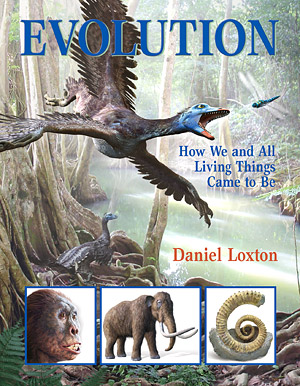 I'm elated to announce that my Junior Skeptic-based book Evolution: How We and All Living Things Came to Be is a 2011 nominee for the prestigious Silver Birch® Nonfiction Award! This is a tremendous honor (for which I thank my illustration collaborator Jim W. W. Smith, my editor Valerie Wyatt at Kids Can Press, producer Pat Linse — and the Skeptics Society for making the project possible in the first place).
Each year, the Ontario Library Association showcases selected titles for its Forest of Reading® program — a heavily-promoted recreational reading initiative, widely supported throughout Ontario's public schools and public libraries. Among the 250,000 participating young readers, kids who read a minimum of five of the 10 books in their reading category will become eligible to vote for the award in that category.
The Forest of Reading program runs throughout the Spring, culminating with award ceremonies in front of an audience of several thousand at Canada’s largest literary event for younger readers: the Festival of Trees™ at the Harbourfront Centre in Toronto (May 11 and 12, 2011).
Continue reading…
comments (26)
by
Brian Dunning, Jul 16 2009

The "PoTo" Artifact
Some readers may be familiar with the “Coso Artifact”, a 1920-era Champion spark plug found inside a chunk of rock. Young Earth Creationists have pointed to this as evidence against evolution. Skeptics, however, find no such proof in the artifact. When ferrous metals are buried in earth, they often rapidly form iron oxide concretions incorporating the surrounding sediment.
This is a chunk of pipe that my son found in Port Townsend, Washington last week. I presume it’s steel. Note how parts of it are completely eaten away, while other parts have ballooned to the point of filling the center of the pipe completely with just such a concretion. Continue reading…
comments (38)
by
Steven Novella, Mar 23 2009
Texas remains a battleground state in the clash between creationists and scientists over science education standards. This week the Texas Board of Education will vote on whether or not to replace the “strengths and weaknesses” language that existed in the state’s science standards for the last 20 years, but was removed this Winter by a narrow 1-vote margin.
The battle represents the latest strategy of creationists to either hamper the teaching of evolution or introduce creationist ideas into the science classroom under the banner of “academic freedom.” The basic concept is that teachers, students, and school systems should have the academic freedom to: teach both the strengths and weaknesses of scientific theories, use outside (unapproved) material in teaching their classes, and believe whatever they wish without penalty.
Academic Freedom
The academic freedom strategy is getting some traction. Americans are generally for freedom, and the bills and language used to promote their agenda with “academic freedom” may appear innocuous on the surface. This strategy is specifically designed to skirt the constitutional barriers to teaching creationism in public schools, and has yet to be tested on constitutional grounds.
Continue reading…
comments (10)
by
Steven Novella, Feb 09 2009
February 12th is the 200th anniversary of the birth of Charles Darwin. This year is also the 150th anniversary of the publication of Origin of the Species – arguably one of the most important scientific publications ever. In honor of Darwin’s idea and the subsequent scientific triumph of evolutionary theory, I am posting my refutation of a popular creationist internet meme. Creationists love to imagine that they have dismantled evolution or discovered it’s “major flaws,” however they only succeed in exposing the major flaws in their understanding of evolution and ability to reason.
TEN MAJOR FLAWS OF EVOLUTION – REVISED
by Randy Alcorn (with additional editing by Jim Darnall). I wrote the following article many years ago, but it needed to be thoroughly revised and updated. Thanks to Jim Darnall for adding some important new information.
1) The complexity of living systems could never evolve by chance—they had to be designed and created. A system that is irreducibly complex has precise components working together to perform the basic function of the system. (A mousetrap is a simple example.) If any part of that system were missing, the system would cease to function. Gradual additions could not account for the origin of such a system. It would have to come together fully formed and integrated. Many living systems exhibit this (vision, blood-clotting, etc.). When you look at a watch, you assume there was a watchmaker. A watch is too complex to “happen” by chance. Yet such living systems are almost infinitely more complex than a watch. They could not be random—they simply had to be designed and created.
This statement is not an argument at all, but merely an assertion. It is simply asserting what appears to be the point of this list of supposed arguments – that evolution through natural forces is impossible. But it contains many implied claims. It refers to irreducible complexity and gives the examples of vision and blood clotting. It does not address the century and a half old refutation of this argument – that biological systems could have evolved from simpler systems that were functional but served a different purpose from their current one. Further, all the examples (stated here and elsewhere) of supposed irreducibly complex systems have been shown to have simpler antecedents.
Continue reading…
comments (267)
by
Steven Novella, Dec 08 2008
Last week I gave an overview of what I believe is one of the core missions of the skeptical movement – to fight the good fight against pseudoscience and mysticism. This week I will discuss what is perhaps our greatest victory to date – our vigilant campaign against creationist incursions.
This one issue nicely illustrates many of the points I made in Part I of this series any may even provide a road map forward for some of our other issues.
A Brief History of Creationism
The various forms of creationism, including its most recent incarnation in so-called Intelligent Design, are really just evolution denial. The theory of evolution has been culturally controversial since it was formally proposed by Darwin and Wallace in 1859. it is not hard to imagine why, it shattered one of the pillars of the human ego – that we are something more than animals, than the accidental products of nature.
Continue reading…
comments (53)