SkepticBlog is a collaboration among some of the most recognized names in promoting science, critical thinking, and skepticism. Regular bloggers include: Brian Dunning, Daniel Loxton, Donald Prothero, Mark Edward, Michael Shermer, and Steven Novella. This site is hosted by the Skeptics Society.
In a major expansion, the Skeptoid science podcast, in English since 2006, is now available in Mandarin on the Chinese iTunes Store and at http://skeptoid.com.cn. This effectively triples the potential listener base, making the award winning show available to more listeners worldwide than any other podcast in any genre.
Host Zhe Li (Lizzie to her English speaking friends) was selected as the favorite from a field of test hosts whose recordings were evaluated by a large focus group of Chinese natives. As a professional translator, she brings a wealth of experience and resources translating even the most obscure technical and scientific terms from Skeptoid. Continue reading…
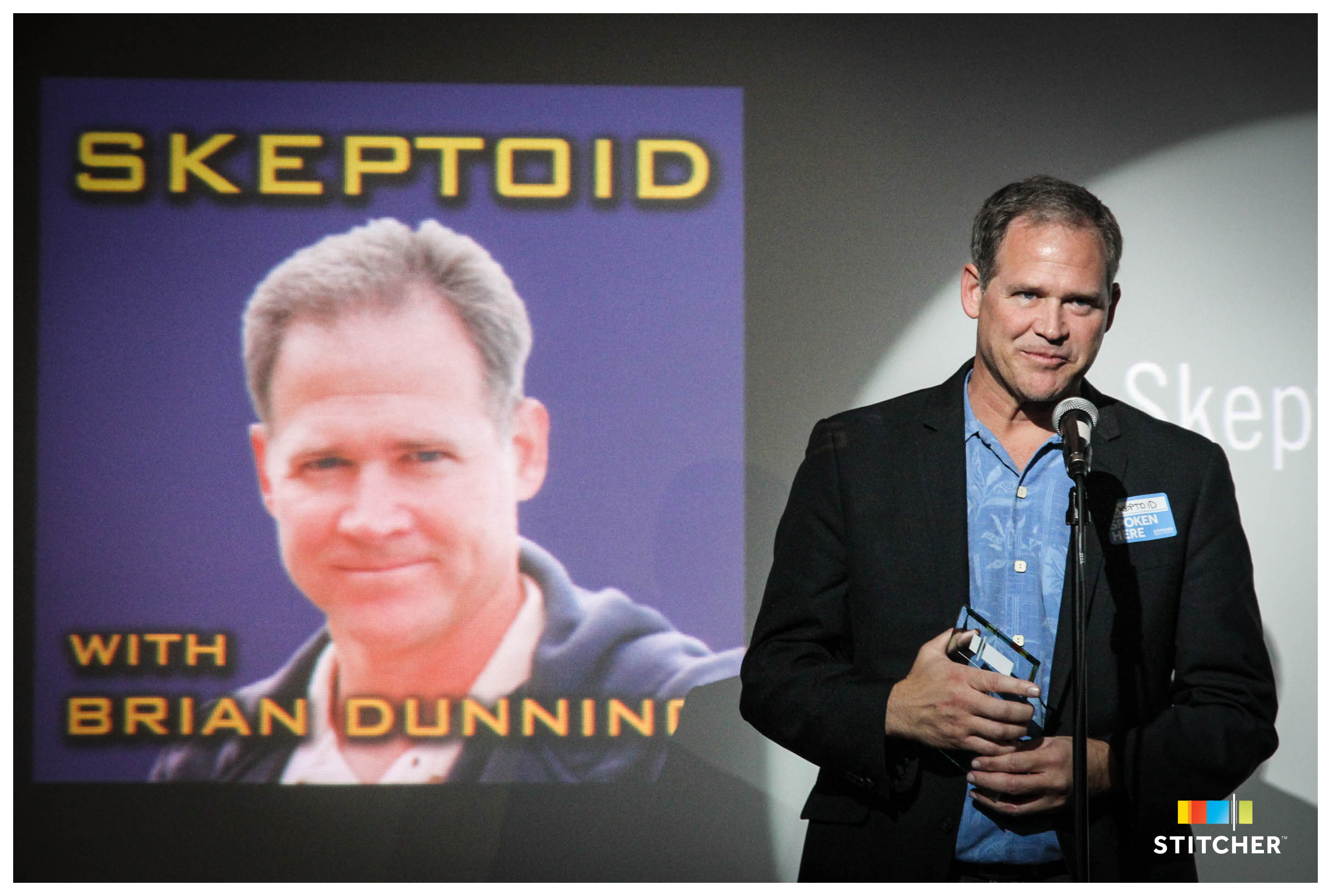
“What is Stitcher?” I asked, in reply to the “Click here to set up your account” email. I’d gotten half a dozen complaints, via email and Twitter, from Skeptoid listeners who found that Skeptoid had disappeared from their Stitcher application. I’d had no idea what Stitcher was. My bad, it so happened. Stitcher is a free app that streams your favorite podcasts and other content, plus recommended similar content. And it turns out that, without my even knowing about it, a lot of my listeners already used it and loved it. It’s no flash in the pan; in fact, your next BMW, Chevy, or GM auto will have a Stitcher button to stream your favorite shows to your car stereo wherever you go.
So that’s Stitcher, a significant player in the Internet audio industry. This year they held their first annual Stitcher Awards for podcasts in a number of categories. When I saw the nominees for Best Science, I was intimidated to say the least:
StarTalk with Neil Degrasse Tyson, a commercial radio program
Science Friday, a radio program from National Public Radio
60-Second Science, from Scientific American
Ask the Naked Scientists, from the British Broadcasting Corporation and Cambridge University
Skeptics Guide to the Universe – An independent show run by 5 people.
The past week or so has seen yet another wave of terrible, terrible reporting in the science media about the Amelia Earhart non-story. We’ve had it a lot this year, ever since TIGHAR — the organization of crank Earhart researcher Ric Gillespie — obtained financing to repeat the Earhart treasure hunt he’s done so many times before for a Discovery Communications TV crew. Gillespie’s completely implausible belief is that Amelia Earhart and navigator Fred Noonan did not crash where history tells us they did in 1937 (off of Howland island), but instead went to Nikumaroro island 650km away where they lived as castaways.
(I’m not going to repeat the details of how we know what we know, and why we can be assured that TIGHAR’s conjecture is bunk, because I’ve already done so in other writings. See the complete Skeptoid episode here, and a follow up blog post here, for the supporting background of my fundamental assumption for this article.)
Predictably, the expedition found nothing. This must have been a huge disappointment for a lot of people, since it got so much attention, even garnering encouraging comments from Secretary of State Hillary Clinton and noted ocean explorer Bob Ballard. The unfortunate part is that if any of the parties who paid the reported $2.2 million cost of Gillespie’s expedition had done even a minimum amount of due diligence, they’d have discovered the same thing I stated in my Skeptoid podcast episode:
TIGHAR’s is a fringe theory supported by poor evidence and that has almost no serious support from mainstream historians or archaeologists. Continue reading…
About a year and a half ago, I learned most of what I know about Morgellons Disease while spending a week researching a Skeptoid episode on the subject. It’s a bizarre condition in which sufferers believe that their skin is extruding strange fibers; sometimes colored, sometimes synthetic, always strange. Doctors and psychiatrists have compared it to delusional parasitosis, where imagined parasites are crawling in and on the skin.
Morgellons was invented (it would not be accurate to say diagnosed) in 2001, by a mom whose toddler son developed an unremarkable raw patch on his chin. When the scab collected fibers — almost certainly from the environment — she believed that they were being extruded from his skin. She took him to doctor after doctor, looking for one who would confirm her belief, but none would. A consensus rose among the doctors that she suffered from Munchausen by Proxy, in which an individual thrives on attention from doctors through presenting a family member as an extraordinary medical case. Reports are that she tried eight different doctors, and when none agreed with her claim, she coined the term Morgellons disease. An active community of Morgellons sufferers has grown worldwide ever since. Continue reading…
As many of you may know, one of my projects is to adapt some of the more popular Skeptoid podcast episodes for the world’s largest single audience venue: YouTube.
I’m posting this blog not so much to make you aware of it, but to solicit your feedback. The show is called inFact with Brian Dunning and is now in its second season. Today’s episode, season 2 number 8, is about conspiracy theorists. Must we assume that they’re nuts, or is there a more rational explanation for why belief in conspiracies is so widespread? See how I answered this question:
Two weeks ago I gave my perspective on the production of Skeptoid #250, The History of Knowledge; which wasn’t perhaps the most insightful because I’m not a musician. I was just the dude standing behind the microphone trying to do what he was told. Some of the comments on the web transcript of the episode were asking for more information about some of the dozen tracks specifically, and so Peter Zachos, who composed and produced the piece, answered. Here are Peter’s remarks, which should interest the musically inclined among you, with [my comments]:
Some people have expressed interest in the behind-the-scenes production of “The History Of Knowledge”. I’m happy to shed some light on how it was done. I work primarily in Pro Tools, using an extensive library of sounds and plug-ins to produce each genre of music. I work out of my studio, ClickClack, in Culver City. This is where we recorded Brian’s vocals, as well as all the guitars and backup vocals.
I’ll go through each track and briefly describe the process: Continue reading…
Recently I did a Skeptoid episode on Scientology, and followed it up with a post here on SkepticBlog to further explain my position. And this was, very much, a position piece… whereas normally with Skeptoid, I compare science to pseudoscience; but as there’s really no science behind Scientology, it was more “Brian’s personal opinion of Scientology”.
To sum up the criticism, it was overwhelmingly that I was too soft on it.
My dream is to start a church and become fabulously wealthy, with the world’s happiest customers. These customers are people who are already believers, whose minds are not about to be changed by a few skeptics. They are going to buy these services: and if they don’t buy them from me, they’re going to buy them from the psychic next door.
In other words, “Hey it’s OK to start a church and take people’s money, because otherwise they’re just going to give it to someone else.” It sounds like it’s not too different from something L. Ron Hubbard might have said. And here’s the kicker: That Skeptoid episode was about ethics.
When I read this comment, I’d completely forgotten about my old remark, and I’ll admit it was pretty eye-opening to have it pointed out. I was like, “Wow, am I really similar to L. Ron Hubbard? Is that why my Scientology episode was so soft?” Continue reading…
After I was finished researching and writing it, I had second thoughts, and decided for a few days that I would shelve it and not produce it, and said so on Twitter. Predictably, lots of people expressed their desire for me to reverse that decision, or that I had decided I was too afraid of Scientology suing me.
In fact, the reverse was true. I was afraid that the episode came out sounding too soft on Scientology. I did not want to be perceived as the pro-Scientology guy, and the episode turned out being less interesting than I'd hoped. But I eventually said “What the heck” and produced it anyway. Continue reading…
I once did a Skeptoid episode about The Lucifer Project, a conspiracy theory prediction that evil government forces are planning to detonate Saturn (sometimes Jupiter) into a small sun. The trigger for this cataclysm is presumed to be a deep space probe, like Cassini, powered by an RTG (radioisotope thermal generator). This concept was popularized by Arthur C. Clarke in his 2001: A Space Odyssey series of books.
Strangely, a few people have not seemed to grasp that this is a fictional concept, with Clarke's characters even pointing out just a few of the many reason such a thing is foolishly implausible:
An RTG could never possibly create an atomic explosion.
An atomic explosion could never possibly convert a gas giant into a sun.
A planet of the mass or composition of any of ours could never possibly achieve fusion.
For the details on any of these wild “could never possibly” claims of mine, see the episode transcript. So how, in light of these barriers, do the conspiracy theorists believe their prediction is going to come to pass? Continue reading…

 In a major expansion, the Skeptoid science podcast, in English since 2006, is now available in Mandarin on the Chinese iTunes Store and at http://skeptoid.com.cn. This effectively triples the potential listener base, making the award winning show available to more listeners worldwide than any other podcast in any genre.