by
Donald Prothero, Jul 16 2014
For years now, we’ve been hearing about Bigfoot believer Melba Ketchum and her supposed results on “Bigfoot DNA”. As reported elsewhere, the results were a bust: the analysis was done incompetently, her reasoning was full of holes and bad science, and she failed to account for a lot of organisms in her sample (such as the American opossum) that explained her “unknowns” that she was calling “Bigfoot.” Not only that, but her paper failed peer review, so she self-published it in a journal she secretly owned, so she gets money every time someone forks up $40 to go past the paywall and read it. Most competent DNA labs are busy with real science, and don’t have the time or money to waste on side trips into pseudoscience, which their grants are not paying for. Continue reading…
comments (9)
by
Donald Prothero, Mar 05 2014
A few months ago, there was a big buzz of publicity for a new show on Spike TV called “The $10 Million Bigfoot Bounty”. As I described in my post shortly after it began, it was a cross between a typical competitive reality show in a rugged location (like “Survivor” or “The Amazing Race”), with a veneer of cryptozoology to give it a new twist. Originally, eight teams of two people were to compete for a $10 million bounty if they found good evidence of Bigfoot, and a $100,000 “research grant” as a consolation prize for the team that did the best even if they didn’t find Bigfoot. The series was hosted by former “Superman” actor Dean Cain, and the judges were molecular anthropologist Dr. Todd Disotell and primatologist Natalia Reagan.
Well, the show finally aired its eighth and last episode (some of which can still be watched on the show’s website). If you were watching a few episodes and want to follow it to the end, I won’t reveal everything and spoil it for you. Suffice it to say that none of the teams were very competent, so the “winner” could have been just about any of the original groups of contestants, except for those who were so completely out of shape and unfamiliar with the woods that they dropped out after a round or two. And it should come as no surprise (since it taped last summer and there were no leaks of amazing discoveries) that no evidence of Bigfoot was found—not even close! Nobody won the $10 million bounty. Instead, the final competition hiking all around the Porcupine Mountains State Park on the Upper Peninsula of Michigan hinged on whether one of the two teams didn’t bicker all the time—since the “evidence” both teams obtained was worthless. In the teaser for the episode, Disotell says they each got primate DNA! And then, after commercial, he finishes his sentence and says that it was human DNA (probably from the “hunters” themselves). Continue reading…
comments (3)
by
Daniel Loxton, Jan 07 2014
Have you heard that Bigfooters finally have the proof we’ve been waiting for? At long last, after half a century of hunting, they have finally gotten their hands on a really seriously genuine Bigfoot body—again! And by astonishing coincidence, this totally completely real Bigfoot body is being offered up to the media by one of the exact same guys who gave us the previous totally real “Georgia Bigfoot” body, way back in the storied yesteryear of 2008. That case was a hoax. As the hoaxers explained, the 2008 “body” was really a costume stuffed with roadkill.
“It’s just a big hoax, a big joke,” said car salesman Rick Dyer. Dyer told Channel 2 he never intended to put it across as the real deal. “It’s bigfoot. Bigfoot doesn’t exist,” he said.
Now that same hoaxer is now back, making headlines with the claim that he shot and killed another Bigfoot. “I’m going to go down in history as the best Bigfoot tracker in the world,” he boasts�—and for some reason we’re talking about it.
Make no mistake, there is a disreputable basement level to Bigfootery, and this is it. I said as much when my Abominable Science! co-author Don Prothero wrote to me a couple of days ago to ask if we should put up a post about it. “It’s really the lowest end of Bigfoot beeswax,” I replied. “I kinda hate to publicize it. I don’t think I’ll bother writing it up at this point.”
Thing is, I’m fond of cryptozoology. I’m really only interested in dealing with the better cases and the more serious practitioners. I think cryptozoologists are mistaken, but that does not mean that I want cryptozoology presented as a complete circus. To that end, for example, I made a conscious choice years ago not to record and use the many interpersonal feuds and slurs that Bigfooters hurl at each other, even though they’ve cooked up some real humdingers. It’s not my job to make monster-hunters appear ridiculous, but to attempt in good faith to find out what’s true. Continue reading…
comments (5)
by
Donald Prothero, Jan 01 2014
For my New Year’s Day post, I thought I’d review some of the important zoological discoveries of 2013, especially regarding new species that have just been discovered. A few weeks ago, the word came out that a new species of tapir (pronounced TAY-pir, they are a pig-sized group of mammals with a long proboscis and three to four toes, distantly related to rhinos) had just been found and formally described. For most of us in the life sciences, this is exciting if not exactly earth-shaking news. As our techniques for identifying new species are getting better and better, we are finding more and more examples of creatures that were known to the local indigenous peoples, but not yet recognized by zoologists. In most cases, these new species are only subtly different from previously described species, so zoologists may have seen the creature before, but not yet recognized that it was a different species from its more familiar close relatives. In many cases, the specimens may have already been collected and were sitting in museums, misidentified. This is particularly true in the case of new species that don’t look that different externally (sibling species), but can be distinguished based on more subtle differences. In the old days, sibling species had to be identified based on things like behavior. Now, there are a number of new species recognized based on molecular differences that are not manifested in anatomical differences we can see with the naked eye. Continue reading…
comments (2)
by
Donald Prothero, Dec 18 2013
This past few days, the internet has been buzzing with conflicting reports that cryptozoologist Roy Mackal has apparently passed away. I first heard about it on Sharon Hill’s Doubtful News site, and it is also reported on Cryptomundo.com. There is also a post from a funeral home in Illinois saying he passed away back on Sept. 13, but apparently no one in the cryptozoology community knew about it until just now. However, I can find no formal obituary for him on the web, and his Wikipedia entry still doesn’t mention it. Born August 1, 1925, he would have been 88 years old, and apparently no one has been in touch with him for a long while, but it’s really surprising that the news is just reaching us three months late. I’m sorry to hear of his passing. I never met the man, but I’ve talked to a lot of people who did, and he seems to have been open and friendly and kind—but also a complete believer in the crazy notions that the Loch Ness monster and Mokele Mbembe were real.
Continue reading…
comments (6)
by
Daniel Loxton, Oct 17 2013
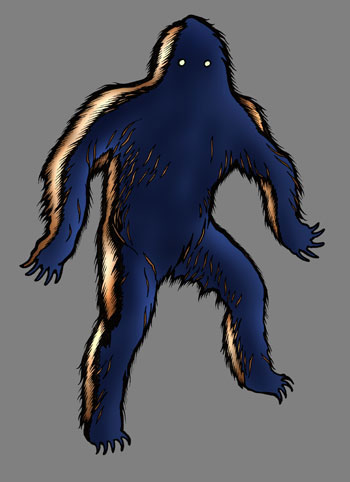
Illustration by Daniel Loxton. Originally published in Junior Skeptic 16, bound inside Skeptic Vol. 10, No. 2 (2003).
Exciting headlines are announcing that Oxford University geneticist Bryan Sykes may have “solved” the long-open case of the legendary Yeti of the Himalayas. According to reports, DNA analysis of alleged Yeti hair samples indicate that the region may be home to previously undocumented species or sub-species of bear.
Bears do live throughout the region: Asiatic black bears, sloth bears, and Himalayan brown bears (Ursus arctos isabellinus, a subspecies of the brown bear, Ursus arctos—grizzlies are another). Of these, the Himalayan brown bear has long been strongly implicated as the real animal behind the legend of the Yeti. I’ve argued this myself in the pages of Junior Skeptic, and Don Prothero and I explore this likelihood in chapter-length detail in our new book Abominable Science!
Continue reading…
comments (14)
by
Donald Prothero, Oct 02 2013
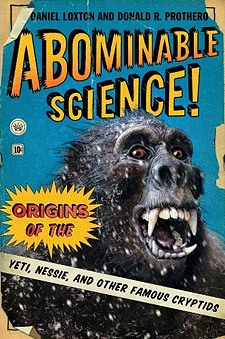
When our new book, Abominable Science: Origins of the Yeti, Nessie, and Other Famous Cryptids, came out at TAM last July, Daniel and I were both wondering what kind of response we would get from the cryptozoology community. Daniel is always more optimistic about people than I am. He felt that at least some cryptozoologists attempt to follow the scientific method and want to be taken seriously as scientists, and they would give the book a fair hearing despite the mountains of evidence we compiled that demolishes their ideas. My expectation was a bit different. My hide is scarred by 40 years of battling creationists, and I’ve seen how facts and evidence and logic don’t matter to people when a skeptic challenges a belief that they hold deeply and which gives them meaning in their lives. We never made a formal bet on the outcome, but it’s been interesting now in the three months since the book has been out what kind of response it has received.
As expected, we got great reviews from the mainstream media and even from some high-profile scientific journals, like Nature, so we knew the book was properly focused and was effective for the general audience. (So far, we have 23 five-star and four-star reviews on its Amazon.com site, and only 5 one-star reviews from cryptozoologists). We even got a couple of half-decent or at least non-condemning reviews from some prominent cryptozoologists, and it was publicized on their websites such as www.cryptomundo.com, giving the cryptozoology community plenty of chance to notice it. But as I expected, more of the reviews from the cryptozoologists have been nasty, unfair, and full of venom, some of which Daniel has addressed in posts about Daniel Perez’s and Bill Munn’s attack on our treatment of Bigfoot, and Roland Watson’s attack on our demolition of the Loch Ness monster myth. Continue reading…
comments (4)
by
Daniel Loxton, Sep 05 2013
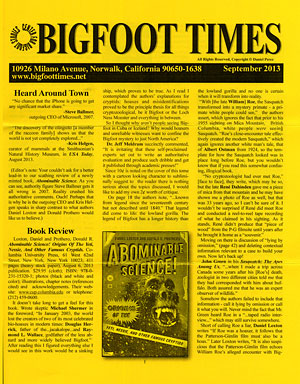 Abominable Science! was the work of several intense years, so you won’t be surprised to hear that its warm reception by media from The Wall Street Journal to Nature is very exciting to me. It may surprise you slightly more to hear that I looked forward with particular interest to the review of Abominable Science! in an altogether smaller, niche publication: the Bigfoot Times newsletter.
It’s appropriate and welcome that the Bigfoot Times should take a crack at a critical review of the book; after all, Don Prothero and I offer a fairly robust critique of cryptozoology (certainly a critique offered in good faith). I was hopeful that they and other cryptozoology proponents would weigh in with substantial contributions about what they see as the merits and roadmap for future development for cryptozoology, while also giving serious, honest consideration of some of the deep problems with the field.
Continue reading…
comments (17)
by
Donald Prothero, Jul 10 2013
I’m on my way to The Amazing Meeting in Las Vegas as this posts, but I wanted to write this as an addendum to our just-published book on cryptozoology, Abominable Science! (available at TAM this weekend, and on Amazon.com). Daniel Loxton and I will both be at TAM if you want to get a copy autographed by both authors.
Last February, the news and blogosphere was buzzing with excitement. Someone had claimed that they had sequenced the DNA of Bigfoot! Naturally, such a sensational story was reported all over the internet and even the mainstream media as if it were solid, confirmed research. If there was any skepticism displayed, it was at the very end of a story that mostly gave the claim uncritical coverage. A number of mainstream scientists and skeptics wrote critical blogs and articles about the way the discovery was announced and the fact that it was announced without a publication backing it up, but everyone had to reserve judgment until the paper was actually published—and even more importantly, when the results were double-checked by an independent lab.
There were lots of reason for doubting the reality of the report. To start with, the researcher, Dr. Melba Ketchum (a long-term Bigfoot advocate, so she is no neutral party) did one of the worst possible things to convince scientists: she put out a press release before any peer-reviewed scientific publication of results. This always makes scientists suspicious, because it is a common strategy among less reputable researchers to get the press to cover substandard or even ridiculous research before scientists could weigh in.
Continue reading…
comments (7)
by
Donald Prothero, Jun 05 2013
As Daniel Loxton and I worked on our magnum opus about cryptozoology (due out in mid-July at TAM), we wrestled with the issues of book length, since our exhaustive research on cryptids like Bigfoot, Nessie, and the Yeti were much longer and more comprehensive than even we imagined at first. We ended up leaving out a few cryptids (like the other lake monsters, and the Chupacabra) that have received excellent book-length debunkings by Ben Radford, Joe Nickell, and others. But even in our wildest imaginations, we never thought we needed to put in a chapter (or even a sentence) about mermaids!
Yet mermaids have just become the hottest new cryptid in the media and cryptozoology community. A year ago, the Animal Planet channel ran a hokey “documentary” on mermaids called “Mermaids: The Body Found”, and got a lot of coverage (and outrage) at the obviously faked “documentary” that was not promoted as fiction. Brian Switek gave it the best assessment: it “embodied the rotting carcass of science TV.” Clearly, however, ratings speak louder than the outrage of skeptics and experts, because last week they did another “documentary” on the same topic. Entitled “Mermaids: The New Evidence,” it wasted a perfectly good 2 hours of airtime on Animal Planet on Sunday night, May 26. It was just like the first program: a lot of moody, dark, poorly lit shots of vague forms and backgrounds, a lot of CG reconstructions of “mermaids”, “re-enactments” shot like the “Blair Witch Project” and presented as real events, but no actual physical or photographic evidence of any kind. The “video footage” was all so poor and blurry that it proved nothing except the incompetence of the videographer. The “money shot” is a distant telephoto image of something on a Greenland ice floe that could just as easily be a seal (and probably was). The entire two hours was filled with this fluff and fakery. Continue reading…
comments (17)