by
Donald Prothero, May 14 2014
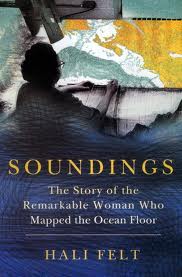
Soundings: The Story of the Remarkable Woman Who Mapped the Ocean Floor by Hali Felt (Henry Holt & Co., New York, 2012)
For almost 70 years we have seen the large maps and globes showing the topography of the world’s oceans and continents, and taken them for granted. The map of the world’s land topography was a hard-won accomplishment made by generations of surveyors and cartographers, gradually improved and refined during the golden ages of exploration in the 1700s and 1800s. But before 1957, over 70% of the earth’s surface was simply unknown. Maps of the world’s oceans showed a few islands on a patch of solid blue, and not much else. Whatever was beneath the ocean’s surface was terra incognita. For the longest time, people thought that trilobites still roamed the seafloor, or that the entire seafloor was a flat featureless plain. Surprisingly, virtually all of the undersea world we now take for granted was mapped by one person! Even more remarkably, that person was a woman in an age where women had few opportunities in science. And sadly, despite the fact that she mapped more of our planet’s surface than any other person in history, her name is virtually unknown except to a few scientists. Fortunately, with the May 4 episode of “Cosmos” that just aired, her name is getting a bit more publicity.
Her name was Marie Tharp, and I was fortunate to meet her and her longtime scientific and romantic partner Bruce Heezen (pronounced HAY-zen) when I was still a graduate student at Lamont-Doherty Geological Observatory in the late 1970s. (Sadly, “Cosmos” mispronounced Heezen they way most people mispronounce it). Writer Hali Felt has produced a very enjoyable biography of this groundbreaking but underappreciated giant in the sciences of geology and geography. She was born in Ypsilanti, Michigan, on July 30, 1920, but she grew up in many different states, and followed a nearly rootless existence, because her father William made soil classification maps for many different state surveys. Always the new kid in town, she seldom made friends in school, but she was very bright and hardworking and did very well in her studies. As she got older, she spent a lot of time riding around with her father helping him in his work, so she learned about geology and natural history and mapping and surveying at a young age. She graduated from Ohio University in 1943 with majors in English and music and four minors. Then she got a master’s in geology at the University of Michigan at time when few women were allowed in geology, but wartime shortages of male students needed for the oil industry opened the door for her. For a while she worked at Stanolind Oil in Tulsa, Oklahoma, earning another degree in Mathematics at the University of Tulsa as she worked. Continue reading…
comments (3)
by
Donald Prothero, Apr 09 2014
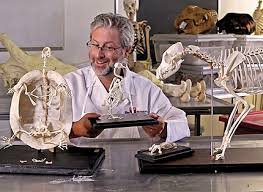
A review of Your Inner Fish, a three-part documentary series airing on PBS beginning on April 9, 2014
In 2008, Neil Shubin published his best-selling book, Your Inner Fish: A Journey into the 3.5-Billion Year History of the Human Body. Based on his experience teaching medical school anatomy at the University of Chicago, the book explored the evidence of our evolutionary past demonstrated in the peculiar jury-rigged anatomy of humans. Interspersed with the anatomical evidence of evolution were stories about his field work discovering important fossils that showed the transition from fish to amphibians (Tiktaalik), as well as other important finds. Shubin’s research is not only in anatomy and paleontology, but also in evolutionary developmental biology (“evo-devo”), so there were many stories in the book detailing the new discoveries in genetics that explain the oddball poorly-designed way we are constructed, and how these genetic mechanisms were inherited from our ancestors. The book was named “Best Book of the Year” by the National Academy of Sciences. After his earlier career at the University of Pennsylvania, Shubin is currently the Robert Bensley Distinguished Service Professor at the University of Chicago and Associate Dean for academic strategy of the university’s Biological Sciences Division. He was elected to the National Academy of Sciences in 2011. Continue reading…
comments (10)
by
Donald Prothero, Apr 02 2014
Civilization exists by geologic consent, subject to change without notice.
—Will Durant
For my post this week, I originally planned to write about the 50th anniversary of the Great Alaska earthquake, March 27, 1964. It was the largest measured quake in U.S. history, measuring 9.2 on the moment magnitude scale, and caused huge amounts of destruction in southern Alaska. It also profoundly changed the science of geology as well, since it proved that subduction zones were real, and showed us how the land changed after subduction zone earthquakes. And then as I finished this post on March 28, the earthquakes along the Puente Hills fault started to roll in. It seemed that earthquakes were the theme of the week!
But then another disaster grabbed the headlines, and pointed to some important issues that seemed even more timely. On Monday, March 24, we heard the news of the gigantic landslide that buried the tiny town of Oso, Washington, about an hour north and east of Seattle. When I originally wrote this (March 28), the official death toll was 25, but over 90 were missing and feared dead. At last count it is 28 dead, 22 still missing. Most of the news coverage of the story focuses on the horrors of thousands of tons of mud and rocks roaring down on people in a matter of seconds, burying them alive or crushing them under the enormous weight of wet mud, ripping houses and cars to shreds, and even shredding the clothes off the bodies of the victims. In the weeks before the slide, over twice the amount of the normal rainfall fell, saturating the ground and increasing the pore pressure so the sediment was like quicksand or wet concrete. The slide material itself was made of ancient glacial lake and valley sediments, mostly porous sand that can absorb a lot of moisture, and is loose and crumbly, so when it is saturated, it will flow. Witnesses described the debris flow as a “fast-moving wall of mud” containing trees and other debris cutting through homes directly beneath the hill. A firefighter stated, “When the slide hit the river, it was like a tsunami”. In numerical terms, the size of the mudflow is staggering. It’s estimated at 15 million cubic yards moved all at once. A Washington state geologist said the slide was one of the largest landslides he’d seen. The mud, soil and rock debris left from the mudslide is 1,500 ft (460 m) long, 4,400 ft (1,300 m) wide and deposited debris 30 to 40 ft (9.1 to 12.2 m) deep.
Continue reading…
comments (28)
by
Donald Prothero, May 01 2013
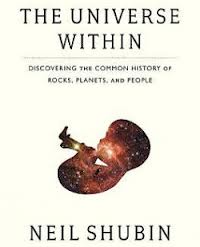
A review of The Universe Within: Discovering the Common History of Rocks, Planets, and People, by Neil Shubin (Pantheon, New York, 2013).
Popularizing science, and writing science trade books for general audiences, is a challenging business. As an author of trade science books myself, I know how hard it is to write a book that sells well. Many of my fellow scientist-writers complain that the trade science book market is vanishing as fewer and fewer people read much any more, and those who do read a lot don’t read non-fiction/science. Only a handful of scientists (Carl Sagan, Isaac Asimov, Stephen Jay Gould, Richard Dawkins, and just a few others) have managed to do it well for a long time. They are among the few that have reached the best-seller lists and achieved celebrity status so they are recognizable names and faces (and some have even appeared on The Simpsons, the ultimate arbiter of pop-culture status). Some of these people (especially Sagan) were attacked and scorned by their scientific peers for being “too popular” and no longer serious about their science, even though studies have shown that Sagan and Gould and the others were just as productive in their peer-reviewed science even as they reached superstar status. On the other hand, many people have cried out for the scientific community to provide us with more Sagans and Goulds who can make science interesting and comprehensible to a public that is becoming increasingly ignorant of science, or sucked into pseudoscience of UFOs and Bigfoot, or the junk science of creationists, anti-vaxxers, and climate change deniers. Continue reading…
comments (2)
by
Donald Prothero, Nov 07 2012
Last winter I received an email from a producer of a BBC reality series, “Conspiracy Road Trip.” The premise of the series is that the host (Andrew Maxwell, a British comedian) travels with five young believers in some crazy idea, taking them to key locations and putting them in front of evidence that challenges their beliefs. They had already done episodes on UFO nuts, the 7/7 bombings in London, and 9/11 Truthers, so naturally the next group of crazies in line were the creationists. The producer explained that he wanted me and a number of other scientists to meet at important locations (I was to film on the rim of the Grand Canyon) and show these creationists the actual scientific evidence, and let them squirm in front of the cameras. After I checked around to make sure it wasn’t some stealth creationist documentary like Ben Stein’s pathetic “Expelled” (which ambushed its subjects like Michael Shermer, Eugenie Scott, P.Z. Myers, and Richard Dawkins under false pretenses), I agreed to travel out there to meet them. Even though I’ve battled creationists in debates and TV panels before, and done documentaries in the field on prehistoric animals, I’d never done something that combined the two. I’ve written and argued enough with creationists to know them and their arguments (and the scientific reality) down pat. Still, I prepared for anything. I even brought along a bunch of real fossils to pass around, and put my key diagrams on a series of huge laminated flip charts.
So in mid-April 2012, they flew me out to Vegas, where the first glitch occurred: they told me to go to the wrong hotel, and it took until later that evening before I reached the right one. Once I did so, I went out to a late dinner with the producer, who looked over my materials, and walked me through his plans for filming. He wanted to hold off my confrontation with them until the cameras were rolling, so he asked me to try to avoid them at breakfast in our hotel that morning. This was nearly impossible since they were only group at breakfast, and one of them recognized me while we waited in the airport. Then we flew out of Henderson, Nevada, airport on small prop planes to see the entire Grand Canyon from the air (an amazing flight that I had never done before). The five creationists and Andrew Maxwell, plus the director and two cameramen were in one plane, while the producer and another camerawoman were in a smaller plane with me. After landing on the South Rim airport, the five creationists then rode in a mini-bus to lunch at Grand Canyon Village (where they tried to chat me up again), then we all went out to Lipan Point on the South Rim, one of the best places for an unobstructed view of the eastern Grand Canyon with no fences and almost no crowds or background noise. After they got a chance to glimpse over the rim, the film crew set me up back to the Canyon and began our first segment. Continue reading…
comments (56)
by
Donald Prothero, Sep 19 2012
Most educated people in modern society have no difficulty accepting the idea that the earth is roughly spherical, or that the sun is the center of the solar system and the earth moves around it. Nearly everyone laughs, or shakes their head in disbelief whenever you tell them about people who seriously believe in a flat earth or groups of people who still don’t accept the discoveries of Galileo and Copernicus after 500 years. Yet both of these long-rejected ideas have strong adherents, mostly creationists who use literal interpretation of the Bible to deny any scientific reality that contradicts scripture. For these people to continue clinging to these long-discredited ideas, they must ignore the hundreds of photos from earth and space that show its true shape (the flat-earthers claim they are NASA hoaxes, although the other international space programs produce similar images). In addition, we now have space probes visiting all the planets on paths predicted by the heliocentric solar system, and some have looked back and taken shots that show the layout of the solar system, and the earth where it really is. But in this age of the internet, silly ideas like geocentrism can reach an audience of millions in seconds, without any fact checking or scientific peer review, which most mainstream media still practice. Any fool with a hot idea, a computer and possibly some decent graphics or animation can cook up a wild theory and instantly generate thousands of hits, and hundreds of favorable comments from those who can’t tell science from garbage. Continue reading…
comments (39)
by
Donald Prothero, Aug 01 2012
One of the great joys of being a geologist is that every summer I try to escape the heat waves of July and August by doing field research in some place with a nicer summer climate. In the late 1990s until 2003, I was funded by the NSF and the Petroleum Research Fund of the American Chemical Society to do paleomagnetic dating on the Cenozoic marine rocks of the Pacific Coast. This meant several weeks each summer in coastal Oregon, Washington, or California, to work during their dry season when the outcrops along creek beds were at their most exposed—and timed for the lowest summer tides, so we could also sample outcrops along beach cliffs. But in the past 10 years, I’ve been doing research nearly every summer up in the high elevation (camping at 8800 feet) of the San Juan Mountains of southwest Colorado. The summer weather here is delightful: dry and in the low 80s at the hottest in the daytime, cooler in the mountains, and nothing like the 100-degree heat waves we hear about on the news scorching the rest of the country.
This particular summer we finally visited one of the great geologic sights of North America, the nearly inaccessible Wheeler Geologic Area in the La Garita Wilderness, north of South Fork and Creede, Colorado. It is one of the few remaining exposures of one of the largest supervolcano eruptions in the last 65 million years. First discovered by Capt. George M. Wheeler, who surveyed it for the U.S. Army in 1874, it is a spectacular cliff amphitheater with huge erosional “hoodoos” (pinnacles and columns) of volcanic rock. It was made Colorado’s first national monument in 1908, but then demoted in 1950 when the government decided not to spend money to make it more accessible, and instead incorporated into the La Garita Wilderness Area. It rivals more famous parks, such as Bryce Canyon in Utah, for its scenic beauty. The big difference, however, is accessibility. Whereas Bryce is visited by millions of people each year, and had roads, trails, railings on the overlooks, and many tourist facilities, Wheeler is almost completely undeveloped. First you must drive almost 20 miles up a decent gravel road from 8000 feet to 11,000 feet to the site of an old abandoned sawmill near Pool Table Mountain. Then there is another 13 miles over one of the worst “roads” I’d ever traveled on, followed by a hard hike at over 12,000 feet in elevation, to reach it. We brought along four-wheel ATVs to attempt the trip, since the “road” is brutal to vehicles and even a Jeep has trouble on the numerous deep flooded washouts and piles of huge rocks that litter the “road”.
Continue reading…
comments (16)
by
Donald Prothero, Nov 09 2011
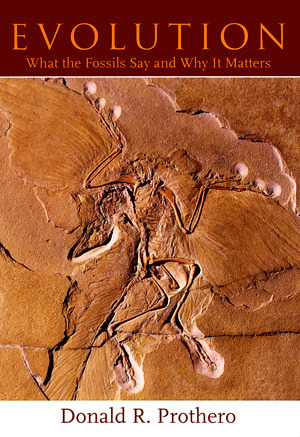
In my October 26 post, I discussed the efforts of creationists to run “stealth” field trips at the annual meeting of the Geological Society of America in Denver in 2010. There were no such attempts at the Minneapolis meeting on Oct. 9-12 that I attended last month, but instead they did something they often do at professional meetings like GSA: stealth abstracts. I saw a bunch of posters from people at Cedarville University, a fundamentalist Baptist institution in Ohio. These posters pretended to be legitimate research about the deposition of the Permian dune sand unit, the Coconino Sandstone. This famous unit in the upper part of the Grand Canyon is clearly formed in wind-blown dunes and not a deposit of Noah’s flood (or of any kind of fluid other than wind). Since their dogma insists that the entire sequence in the Grand Canyon is laid down by Noah’s flood, the Coconino is a particular problem for them, and they focus their attention on it. (See the evidence and discussion in Chapter 3 in my book Evolution).
The posters were stuck in a session with a bunch of other posters presenting more conventional research into sandstones, and they looked professional enough that no one would notice. Other than their Cedarville affiliation, there was no clue about their creationist agenda, and there was no mention at the end of the abstract, or the conclusions section of the poster, that they were shilling for anti-scientific creationist views. I repeatedly walked past both posters during the day they were up, but never once found the authors defending it, even during the time that the GSA demands that “Authors will be present”.
Continue reading…
comments (35)
by
Donald Prothero, Oct 26 2011
The Geological Society of America (GSA) is one of the largest organizations of geologists in the world (over 24,000 members). It holds not only an annual meeting every fall in a different city, but also five regional meetings around the U.S. regions (Northeast, Southeast, Midwest, Rocky Mountains, and Cordilleran) throughout the year. Although 97 different countries contribute members, it is composed mostly of U.S., Canadian, and some Central American geologists. The GSA focuses on the cutting-edge and pure research aspects of geology, performed mostly by academics and government geologists. Thus, it is very different from meetings of petroleum geologists or mining geologists or engineering geologists, who tend to be employed in for-profit enterprises and focus on purely practical local problems. The annual GSA meeting routinely draws 6000 or more people for a four-day session, so there are over 2000 talks and posters in at least 30 different sessions with talks every 15 minutes in at least 30 different rooms scattered around some huge convention center. There SO much to see and hear for a broadly trained and wide-ranging geologist/ paleontologist like myself that I can’t even catch a fraction of what I want to see and hear. For me, it is crucial to make the annual meeting each year to keep up with the latest developments, as well as see old friends that I see only at the meetings, and also to keep up with my geology textbooks and my other books sold in the gigantic exhibits area. I attended my first meeting in 1978 in Toronto, and I have not missed a national GSA since then. I just returned from this fall’s meeting in Minneapolis October 9-12, which was my 33rd in a row.
Most of the time when I attend the meetings, there are plenty of controversial topics and great debates going on within the geological community, so the profession does not suppress unorthodox opinions or play political games. This is the way it should be in any genuine scientific discipline. I’ve seen amazingly confrontational knock-down-drag-out sessions about particularly hotly debated ideas, but always conducted in a spirit of honest scientific exchange and always hewing to rules of science and naturalism. To get on the meeting program, scientists must propose to organize sessions around particular themes, along with field trips to geologically interesting sites within driving distance of the convention city, and the GSA host committee reads and approves these proposals. But every once in a while, I see a poster title and abstract with something suspicious about it. When I check the authors, they turn out to be Young-Earth Creationists (YEC) who claim the earth is only 6000 years old and all of geology can be explained by Noah’s flood. When I visit the poster session, it’s usually mobbed by real geologists giving the YECs a real grilling, even though the poster is ostensibly about some reasonable geologic topic, like polystrate trees in Yellowstone, and there is no overt mention of Noah’s flood in the poster. But the 2010 meeting last year in Denver took the cake: there was a whole field trip run by YECs who did not identify their agenda, and pretended that they were doing conventional geology—until you read between the lines.
Continue reading…
comments (27)
by
Donald Prothero, Apr 20 2011
The good thing about science is that it’s true whether or not you believe in it.
—Astrophysicist Neil DeGrasse Tyson, on “Real Time With Bill Maher”, Feb. 4, 2011
Reality is that which, when you stop believing in it, doesn’t go away.
—Philip K. Dick, author
It is far better to grasp the universe as it really is than to persist in delusion, however satisfying and reassuring.
—Carl Sagan
In recent years, both philosophers and science deniers (such as creationists) have repeatedly attacked the objectivity of science and scientists. Creationists claim that scientists are big frauds, deceived by a mass delusion about evolution. They argue that the stratigraphic sequence of fossils in the rock record is faked by evolutionists who shuffle the fossils and the strata in the order they need to prove evolution, then allegedly point to the same sequence as proof of evolution. (Never mind the fact that the objective, empirical sequence of fossils through geologic time was worked out by devoutly religious naturalists like William Smith and Georges Cuvier before 1800, at least 50 years before evolution was published by Charles Darwin). The Creation “Museum” in Kentucky is built upon the basic premise that “evolution scientists” and “creation scientists” start with the same data, but view them with different assumptions about the world–the fossils cannot speak for themselves, nor can the evidence falsify one position or the other.
On the other hand, philosophers and cultural critics have attacked science as well. Some philosophers have argued that outside reality is an illusion, and we can only know what we personally experience. If we do not perceive it, reality does not exist. More recently, the fad for deconstructionism in the non-scientific realms of academia argues that all our ideas are so culturally based and biased by our human prejudices that we cannot decide what is “real” or “objective.” This argumentation has gone in circles within philosophy for centuries. Philosophers of science, in particular, are fond of telling scientists what they should do, often without finding out what scientists actually do. Continue reading…
comments (38)