by
Donald Prothero, Oct 23 2013

I have come to a conclusion that one useless man is a shame, two is a law firm, and three or more is a congress.
—John Adams
Suppose you were an idiot, and suppose you were a member of Congress; but I repeat myself.
—Mark Twain
Over the past three weeks, we got to see an extraordinary demonstration of Kabuki theater: politicians posturing and speechifying and saying silly and downright seditious things, all to placate their voter “base” that believes the idiocy they spew. I won’t dwell on the details, but anyone who remembers their “Schoolhouse Rock” realizes that the Affordable Care Act (ACA) is already the law of the land: passed by both Houses of Congress in 2010, signed by the President, and upheld by the Supreme Court last year, it cannot be changed unless its opponents capture majorities in both Houses of Congress and the Presidency. Since Obama campaigned on the ACA in 2012, and Romney campaigned against it, and Obama won the presidency by over 5 million votes (and the GOP lost seats in both Houses of Congress), it is clear that the “repeal” of the ACA was rejected by the voters as well. Surely most of the members of Congress, who are typically lawyers and took constitutional law, know this. Instead, we get this farce about “defunding Obamacare.” Never mind that the GOP doesn’t have the votes to do this; never mind the fact that most of the ACA is already in place, or going into effect the day the stalemate started with a stampede of people signing up to join it; never mind that much of the spending is mandatory and cannot be changed by Congress. As Igor Volsky pointed out:
“Inter-party squabbling aside, defunding Obamacare in the continuing resolution would only target the parts of the law that are subject to annual appropriations. The pillars of reform — Medicaid expansion, the subsidies used to buy insurance — are exempt from this process and are funded through so-called “mandatory” spending and have permanent funding authority. The Department of Health and Human Services, the agency tasked with implementing reform, also “has the ability to fund related provisions without seeking additional appropriations from Congress.”
Continue reading…
comments (15)
by
Donald Prothero, May 22 2013
The saddest aspect of life right now is that science gathers knowledge faster than society gathers wisdom
—Isaac Asimov
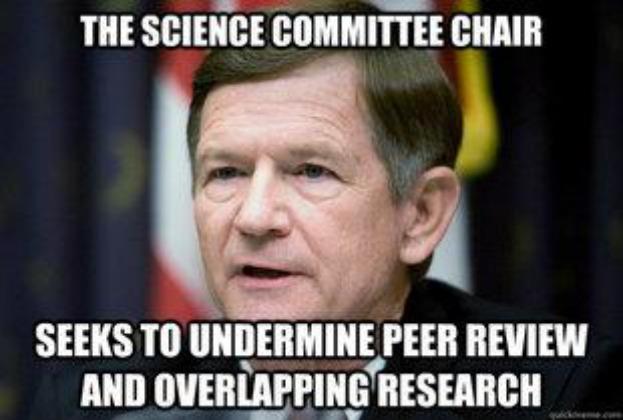
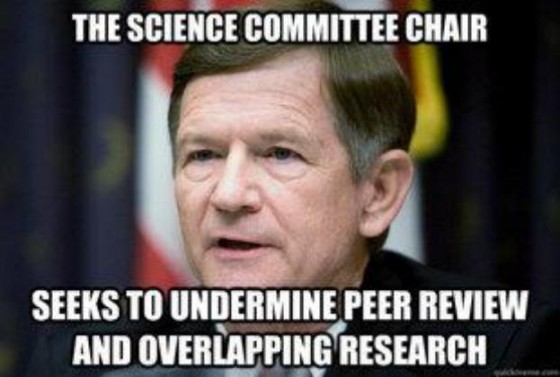
A few weeks ago, we heard in the news the chilling and alarming statement that Rep. Lamar Smith (R-TX), chair of the House Science and Technology Committee, wants to subject all the scientific research grants of the National Science Foundation (NSF) to political scrutiny. No longer was it sufficient that the NSF conduct peer review of grants by experts in the field to determine whether they are worthy of funding. No, the House Committee has decided that they are better judges of good science that the scientific community itself, and they ought to be able to override the decisions of scientists who work in the field.
We’ve seen this kind of political interference in science before, but never at such a high level. Even more disturbing, the GOP members of the House Science and Technology Committee are not the kind of people that most of us would want judging the quality of science. They are nearly all science deniers of one sort or another. This committee includes such luminaries as Rep. Paul Broun of Georgia (an M.D., even!), who said (in a recent speech at the Liberty Baptist Church Sportsman’s Banquet):
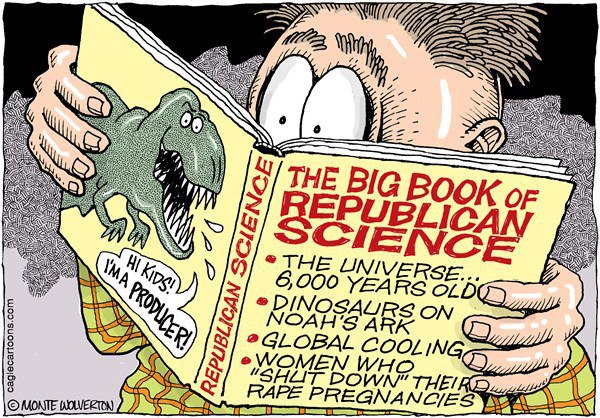
“God’s word is true. I’ve come to understand that. All that stuff I was taught about evolution, embryology, Big Bang theory, all that is lies straight from the pit of hell. It’s lies to try to keep me and all the folks who are taught that from understanding that they need a savior. There’s a lot of scientific data that I found out as a scientist [note: Broun is NOT a real scientist] that actually show that this is really a young Earth. I believe that the Earth is about 9,000 years old. I believe that it was created in six days as we know them. That’s what the Bible says. And what I’ve come to learn is that it’s the manufacturer’s handbook, is what I call it. It teaches us how to run our lives individually. How to run our families, how to run our churches. But it teaches us how to run all our public policy and everything in society. And that’s the reason, as your congressman, I hold the Holy Bible as being the major directions to me of how I vote in Washington, D.C., and I’ll continue to do that.”
Continue reading…
comments (73)
by
Donald Prothero, Oct 24 2012
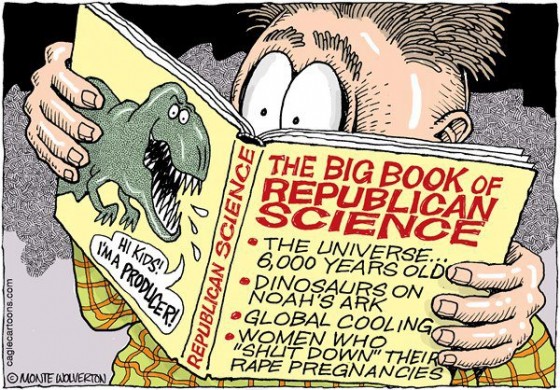
The news recently has been full of shocking and disconcerting quotes from the members of Congress. The most outrageous is by Rep. Paul Broun of Georgia (an M.D., even!), who said (in a recent speech at the Liberty Baptist Church Sportsman’s Banquet):
“God’s word is true. I’ve come to understand that. All that stuff I was taught about evolution, embryology, Big Bang theory, all that is lies straight from the pit of hell. It’s lies to try to keep me and all the folks who are taught that from understanding that they need a savior. There’s a lot of scientific data that I found out as a scientist [note: Broun is NOT a real scientist] that actually show that this is really a young Earth. I believe that the Earth is about 9,000 years old. I believe that it was created in six days as we know them. That’s what the Bible says. And what I’ve come to learn is that it’s the manufacturer’s handbook, is what I call it. It teaches us how to run our lives individually. How to run our families, how to run our churches. But it teaches us how to run all our public policy and everything in society. And that’s the reason, as your congressman, I hold the Holy Bible as being the major directions to me of how I vote in Washington, D.C., and I’ll continue to do that.”
When he heard this statement, Bill Nye said:
“Since the economic future of the United States depends on our tradition of technological innovation, Representative Broun’s views are not in the national interest,” Nye told The Huffington Post in an email. “For example, the Earth is simply not 9,000 years old,” he continued, contradicting a remark made by Broun later in the video. “He is, by any measure, unqualified to make decisions about science, space, and technology.”
Continue reading…
comments (55)
by
Steven Novella, Sep 10 2012
ScienceDebate.org is a group dedicated to promoting the discussion of important scientific issues in American politics. They formed around the idea of holding a science-themed debate in the 2008 presidential election, and have continued since then. They were never successful in getting the two campaigns to agree to a live debate concerning scientific topics, but they did agree to submit written answers to questions. This time around, in the 2012 presidential election, it also appears that there will be no live debate, but both campaigns have submitted written answers to science questions.
The idea behind ScienceDebate is this – from their website:
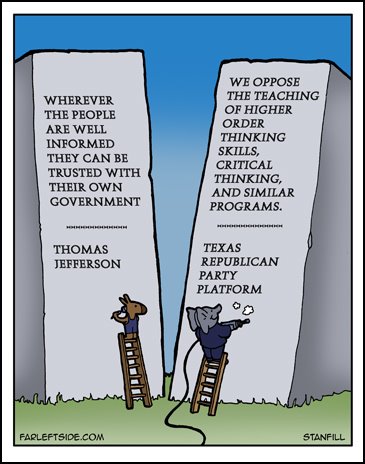
“Whenever the people are well-informed,” Thomas Jefferson wrote, “they can be trusted with their own government.”
Science now affects every aspect of life and is an increasingly important topic in national policymaking.
I remember Carl Sagan hitting this theme often, in Cosmos and in his interviews. He said, for example:
“We live in a society exquisitely dependent on science and technology, in which hardly anyone knows anything about science and technology.”
Continue reading…
comments (9)
by
Donald Prothero, Aug 29 2012
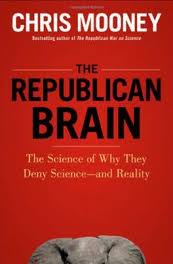
A Review of The Republican Brain: The Science of Why they Deny Science—and Reality by Chris Mooney, John Wiley, New York, 327 pages.
Reality has a well-known liberal bias.
—Stephen Colbert
Anti-intellectualism has been a constant thread winding its way through our political and cultural life, nurtured by the false notion that democracy means that ‘my ignorance is just as good as your knowledge’.
—Isaac Asimov
You can’t convince of believer of anything, for their belief is not based on evidence but on a deep-seated need to believe.
—Carl Sagan
Hearing the speakers at the GOP convention spout their ideas this week, I’m again reminded that an entire American political party is proudly and openly espousing views that are demonstrably contrary to reality, from claiming that rape does not cause pregnancy, to claiming that global climate change is a hoax, to even weirder idea, like the bizarre notion that the President of the United States is a Kenyan Muslim. For years, I’ve puzzled over why people can believe such weird things as creationism or other kinds of pseudoscience and science denials. In my 2007 book Evolution: What the Fossils Say and Why it Matters, I devoted an entire chapter to asking why creationists can so confidently believe patently false ideas, and refuse to look at any evidence placed in front of them. I’ve compared it to Alice’s Adventures Through the Looking Glass, where Alice steps through the mirror and finds that the objects and the landscape look vaguely familiar—but all the rules of logic are reversed or turned inside out. How can people continue to believe things that are clearly wrong, and refuse to change their ideas or look at evidence? Continue reading…
comments (125)
by
Donald Prothero, Jul 18 2012
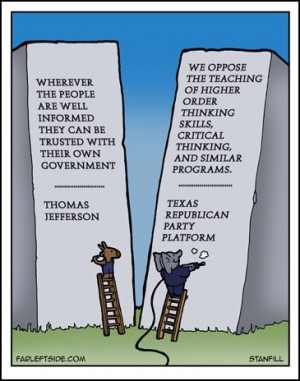
No matter what our political or religious persuasions in the skeptical community, we all hold to some basic ground rules of skepticism. We all agree that critical thinking and questioning authority is a good thing, that humans are easily misled into all sorts of errors of logic, and that it’s easy for any of us to be fooled. Many of our skeptic books are largely about the topic of critical thinking, and the recent efforts by the Skeptic Society to promote critical thinking courses in colleges and universities across the nation are just part of this. Every meeting of CSI, JREF, and other skeptical organizations remind us that critical thinking and questioning authority are essential to getting past the garbage that clutters human thinking and behavior.
In emphasizing critical thinking, we are fully aware that there are powerful organizations (especially religious and some political organizations) that don’t want us to think critically, don’t want us to ask questions, don’t want us to challenge their authority. Many of us are deeply involved in battling religious interference in science and science education, or political interference in scientific and educational decisions made by organizations with clear agendas that don’t stand up to critical scrutiny. Many of us were raised in Sunday School classes where we asked tough questions and were told to shut up, or to stop disrupting class, or something to avoid the fact that the Sunday School teacher had no good answer for that question. We can imagine powerful politicians and their people chatting among themselves privately that those damned skeptics keep messing things up, and we have to stop their interference. Continue reading…
comments (59)
by
Donald Prothero, Feb 01 2012
It pops up in the news every few years, typically when eager politicians are looking for a cause to champion and raise voter anger, and make themselves popular as “guardians of our tax dollars.” The latest version is a recent article in The Los Angeles Times about “duh” science: research that appears to confirm what people regard as everyday knowledge. They included studies that demonstrated that alcohol reduces reaction time; that obese men have a lower chance of getting married; that people who live in safe well-lit neighborhoods are more likely to walk and get exercise; and that college drinking is just as bad as we all thought, but not worse than expected. Such stories are then grabbed out of context and flogged on talk shows as examples of government waste, and become the staple of politicians from both sides of the aisle, eager to enhance their standing with voters.
In this recent incarnation, Senator Tom Coburn (R.-OK) is castigating studies funded by the National Science Foundation which seem silly or frivolous to outsiders to bolster his cred as an anti-waste, anti-tax crusader. He has repeated called for the elimination of the NSF altogether, although he has no idea where American scientists would get their funding if he did so. In past years, the charge was led by Rep. John Dingell (D.-MI), who has served in the House since 1955, the longest serving member of the current Congress. A generation ago, it was Sen. William Proxmire (D-WI), who replaced Joe McCarthy in the Senate and served for 44 years. Proxmire created the famous “Golden Fleece” awards, which publicize what he regards as useless research. Or take a recent quote from that paragon of education and science, Sarah Palin, is in the same vein: “Some of these pet projects, they don’t really make a whole lot of sense and sometimes these dollars they go to projects having little or nothing to do with the public good, things like fruit fly research.”
Continue reading…
comments (114)
by
Donald Prothero, Nov 16 2011

Many readers of this blog will recognize the name of Rolling Stone writer and journalist Matt Taibbi. A gonzo investigative journalist in the style of Hunter Thompson, he was a regular correspondent on Real Time with Bill Maher during the 2008 election. He routinely cracked up the panel with his witty and savage comments, and has also appeared frequently on The Rachel Maddow Show. Famous for his lacerating political commentary and analysis, he has a long track record covering not only U.S. politics, but also he was embedded with the troops in Iraq (described in the book reviewed here), spent a number of years in Moscow as a correspondent, and has worked all over the world as a journalist. He even played professional baseball in Moscow and professional basketball in Mongolia, and had to flee Uzkbekistan after offending the president.
Even though it is now a few years old, I finally got the chance to read his 2008 book The Great Derangement: A Terrifying True Story of War, Politics and Religion, which spent many weeks on The New York Times best-seller list. The events described in the book occurred from about 2005-2008, so they seem a bit dated in the perspective of what has happened since the 2008 elections. But in most respects the same groups are saying and doing the same things, and in some cases, the actions of people and the events since 2008 are even more deranged and unhinged than they were when he wrote his book, so his wickedly funny analysis is even more apropos.
Continue reading…
comments (62)
by
Donald Prothero, Oct 05 2011
Reality must take precedence over public relations, for Nature cannot be fooled.
—Richard Feynman
To treat your facts with imagination is one thing, but to imagine your facts is another.
—John Burroughs
Reality is that which, when you stop believing in it, doesn’t go away.
—Philip K. Dick, author
You are entitled to your own opinion, but you are not entitled to your own facts.
—Former Sen. Daniel Patrick Moynihan, 2003
What’s real is what’s real, and, like it or not, no one can change the nature of reality. Except, of course, with mushrooms.
—Bill Maher
It happens so often that we are inured and desensitized to it. Creationists spout lies and distortions about science and reality, and no one disputes them (except an occasional high school student who challenged Michele Bachmann’s assertion that Nobelists denied evolution). Politicians like Rick Perry and Bachmann get up and brag about their doubts about the reality of global climate change and evolution, and they become the darlings of the GOP. Partisan media like Fox News and their parent company NewsCorp admit that they are receiving money from GOP candidates, or funneling it to them, and no one seems to care. News Corp and Rupert Murdoch get away with all sorts of outrages in their tabloids, yet they are so powerful that British politicians and cops dare not cross them—until their actions are so extreme that all of the UK is disgusted with them. But every once in a while, the cat is let out of the bag, and someone says something that reveals how these people are either abysmally ignorant of reality because of deluded ideology, or they are smart enough to recognize it but play along in a cynical grab for power over those who are ignorant or ill informed.
The latest incident occurred when two pundits on Fox News were discussing the GOP candidates. They point to Jon Huntsman as the sole candidate who would admit that global warming is real (Romney, Gingrich, and others who also once admitted it are now backtracking to kowtow to the extremists who vote in GOP primaries and caucuses). They comment that he’s losing ground to Rick Perry, who made false claims not only about global warming but also about how scientists were allegedly committing fraud. One of the Fox anchors, Clayton Morris, says it it in no uncertain terms:
Certainly, if you dive into the weeds a little bit on this global warming thing, you see that it seems the facts are certainly on Huntsman’s side on all of this and fact checkers have come out, and we’re actually having our own brain room look at this right now, that any of Perry’s comments don’t seem to hold a lot of water. But it doesn’t matter, because what’s resonating right now in South Carolina is helping Governor Perry tremendously. He fired back at Huntsman on global warming and gaining traction, facts or not.
Continue reading…
comments (66)
by
Brian Dunning, Feb 03 2011
It's probably my own naïveté, but I'm constantly disappointed how so many science questions that I research turn out to be political questions.
I consistently find that the conservative attitude on many science questions tends to be “everything's fine” and the liberal attitude tends to be “the sky is falling”. And, of course, that's exactly what conservative and liberal mean: Conserve things the way they are, and change things liberally. I don't find that either viewpoint is especially more likely to represent the current science more than the other. Conservatives tend to be more accurate in their assessments of food production and medical science; liberals tend to better represent actual science in their perspectives on evolution and climate change. Some issues, such as the environment, are torn right down the middle, with extremists on both ends being about equally wrong, and the moderates being about equally right. Too many fans of science tend to express their fandom only when the science matches the ideology. Continue reading…
comments (206)