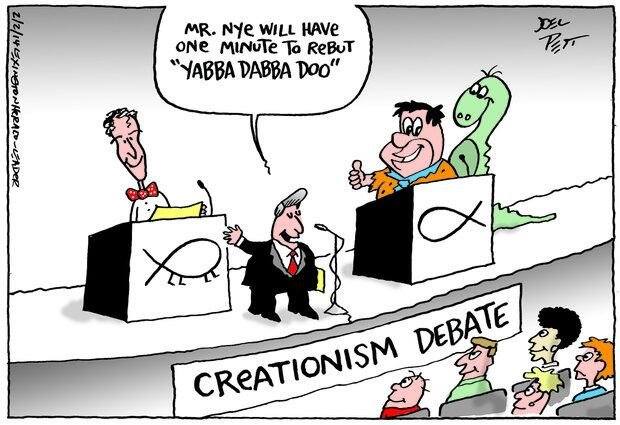
by
Donald Prothero, Sep 04 2014
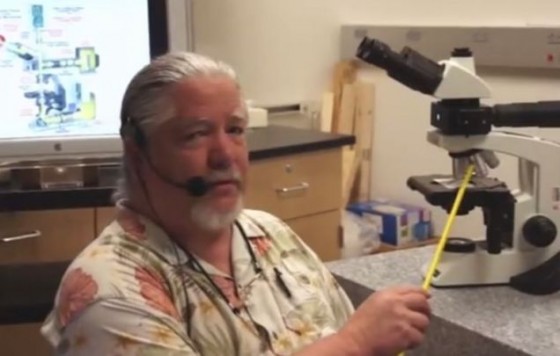
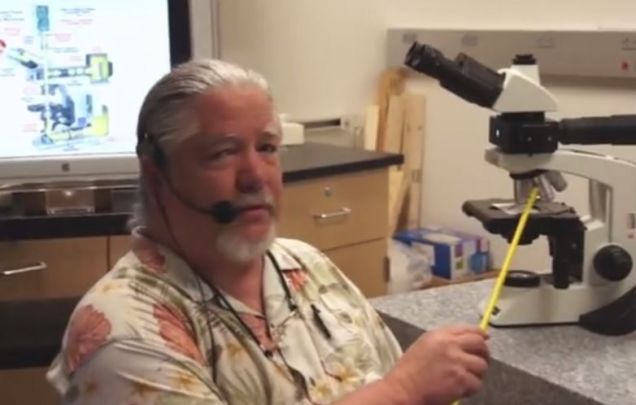
CSUN lab technician Mark Armitage, was fired after publishing creationist ideas and preaching creationism in his Biology Department job
A few weeks ago, a story broke in the news about a creationist working in the Biology Department at California State University Northridge (CSUN), who was fired for pushing creationism in the department. The story exploded across the internet, especially among the creationist organizations who are once again claiming persecution by scientists. CSUN apparently botched both the hiring of this guy, and now his dismissal, so they’ve been sued and this is going to play out badly for them in the courts. But the entire case raises larger issues that are not easily resolved.
First, the facts of the case. The plaintiff is Mark H. Armitage, a microscope technician (not a professional biologist). He did some undergrad work in Biology at University of Florida, but didn’t graduate. Then he got his B.S. in Education from Jerry Falwell’s fundamentalist Liberty University, and his M.S. in Biology (parasitology) from the Institute of Creation Research, an unaccredited fundamentalist organization that has since left California and closed down its graduate program. As many others have shown, the ICR “Master’s Degree” was a sham, consisting of little more that incompetently done book reports and quote-mining from legitimate scientific literature with a creationist spin, not legitimate scientific research. I’ve seen a number of “master’s theses” from there—they are so bad they wouldn’t even pass for a freshman book report. Prior to his employment at CSUN, he was employed as a microscope technician at a variety of Christian schools. But he has no Ph.D., no formal training or peer-reviewed published research in the histology he was working on. He’s just a humble lab tech on a 2-day a week part-time gig, with no guarantee of employment from one semester to the next. His sole job is to maintain and keep track of the microscopes in a big department with hundreds of them, not to teach courses or do research. Continue reading…
comments (28)
by
Donald Prothero, Aug 13 2014
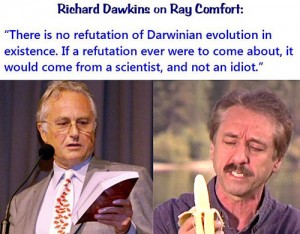
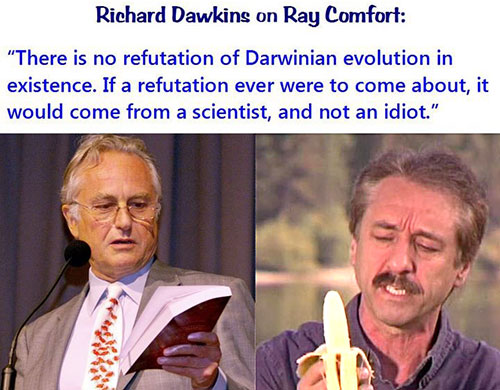
Followers of the evolution-creation wars in this country have heard about Ray Comfort, a glorified street preacher with limited education (he has no college degree) from New Zealand who runs a ministry out of Bellflower, California, called the “Living Waters.” In his appearance, he reminds me of Sonny Bono, except he’s not as smart. He is very prominent on the internet, with dozens of videos (especially his “Way of the Master” series) pushing his theology, and especially attacking evolution. His publicity and high visibility have sold lots of his books (most of which are short titles cobbled together by reprinting stuff from the public domain). Together with washed-up actor Kirk Cameron, they have been constant gadflies preaching against science and evolution, and doing anything possible to generate publicity and sales, especially challenging evolutionists to pointless debates.
I first saw Comfort in action when he and some of his minions came to stalk the huge crowds gathered to hear Richard Dawkins speak at Caltech for a Skeptic Society event. They mingled about, trying to preach creationism, and handing out their little paperback versions of Darwin’s “On the Origin of Species.” However, this book is no true work of Darwin. Comfort has deliberately edited the text to make it sound favorable to creationism, and added a long introduction that is one debunked creationist trope after another. Keeping with his habit of stalking scientists and secularists, I next saw him at a freethought convention in Orange County, where he snuck in without paying for the conference, and tried to interview some of the speakers. He baited P.Z. Myers into an interview, and P.Z. willingly talked to him, not caring that Comfort would selectively edit the interview to make it sound like P.Z. doubted evolution. Unlike the other big fundamentalist creationist ministers who focus on their own flock, Comfort’s approach is as a stalker and gadfly. His mission is to gather video footage that he can take back to his editing room and webmaster, and edit it down to create a “gotcha” moment and make secularists look foolish. Continue reading…
comments (46)
by
Donald Prothero, Jul 09 2014
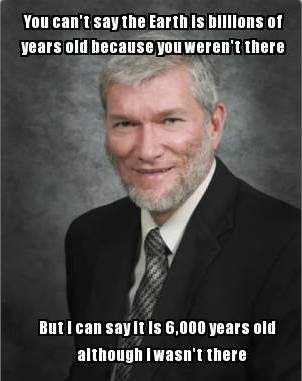
I am leaving for The Amazing Meeting this morning (I speak at 11:00 on Sunday, if you’re attending), but I had dinner with Bill Nye last night (who is a keynote speaker at TAM). We got to talking about his victory over Ken Ham in the debate last February 4. The week before the debate, both the NCSE and Michael Shermer and I had helped coach him on what to expect and how to approach the event. During our session at Shermer’s house, Bill was especially interested in having me explain how radiometric dating worked, and how to handle creationist lies about it. In the debate, Bill did the smart thing and give example after example of clear-cut things that demonstrated the earth was older than 6000 years: tree rings and the oldest trees, ice cores that have 680,000 continuous seasonal bands recorded in them, objects that are hundreds to millions of light-years away, etc. However, he was stumped when Ham dragged out a long-debunked creationist trope about a volcanic lava in Australia dated at 45 m.y. which surrounded trees which were radiocarbon dated at 40,000 years old. In such a short coaching session, it was not possible to explain to him about every creationist distortion of radiometric dating. Luckily, the example slipped past the attention of the audience quickly, and made no difference in the long run (nor did any specific point—as I said before, the debate was about perception and winning “hearts and minds”). Continue reading…
comments (18)
by
Donald Prothero, Jul 02 2014
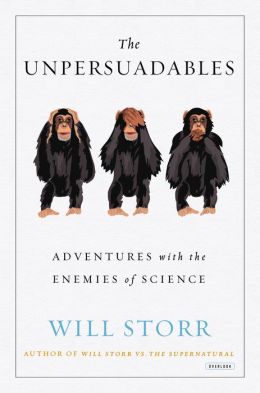
A review of The Unpersuadables: Adventures with the Enemies of Science, by Will Storr (2014, Overlook Press, New York).
Most of us long-term skeptics have had our share of run-ins with people who cling stubbornly to a particular dogma. We get frustrated that no amount of evidence or strong arguments ever changes their point of view. The pattern is true whether you’re dealing with religious beliefs (from creationism to various Eastern religious ideas), or paranormal beliefs (UFO nuts, psychics, ghosts, cryptozoology) or just plain pseudoscience and bad scholarship (homeopathy, past-life regression, Holocaust deniers, climate-change deniers, and many others). Reporter Will Storr decided to go deep into the heart of these various fringe and non-scientific belief systems, interviewing the major figures, taking part in their rituals, and doing his best to give them a fair shake as he embeds himself into their culture. Continue reading…
comments (10)
by
Donald Prothero, Jun 17 2014
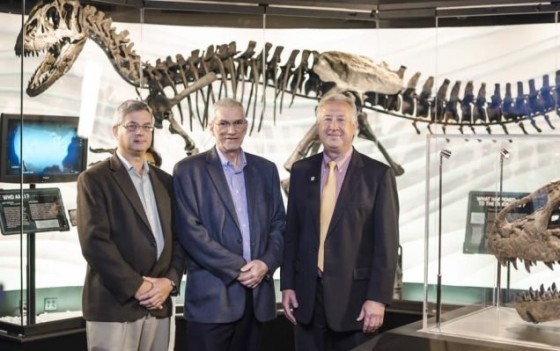
The allosaur “Ebenezer” with “geologist” Andrew Snelling, Ken Ham, and racist Michael Peroutka, the donor
There’s a sucker born every minute.
—Attributed to P.T. Barnum
The crazy story of Ken Ham’s Answers in Genesis organization and their ambitious plans keeps getting stranger and stranger. Just a few weeks ago, Ham crowed about having a real Allosaurus skeleton (nicknamed Ebenezer) on display in his Creation “Museum”—a sad loss of an important specimen to science. Not only will it have no sound scientific data to accompany it, but instead it’s going to have the weird pseudoscience of creationist “flood geology” used to interpret it, and provides the creationists with something to brag about. The Creation “Museum” is having their resident “flood geologist” Andrew Snelling study the specimen—even though he doesn’t have any training in paleontology, doesn’t know one bone from another, and obtained his only legitimate training in uranium geology. As blogger Artiofab discovered, the collection was done on a ranch in Colorado by a bunch of creationist students and home-schoolers, and no one with legitimate training in paleontology, taphonomy or sedimentary geology involved or collecting proper data—just “flood geologists” with their distorted view of the geologic record.
As blogger Artiofab commented:
As you can see from photographs of Ebenezer, this specimen no longer has its original preservation; each skeletal element has been prepared out of matrix, presumably during the more than ten years that its private owners had access to it. Have samples of the matrix been saved for future geochemical work on the depositional environment of Ebenezer? If not, then this data is gone, and Ebenezer is devoid of environmental data.Without information from the Creation “Museum”, I have no way of knowing how data-deficient Ebenezer is. Ebenezer could have field notes, photographs of the excavation, and rock matrix samples stored away somewhere. If Ebenezer has these things, then Ebenezer is useful to science. If Ebenezer does not, then Ebenezer is useless scientifically.
Continue reading…
comments (39)
by
Donald Prothero, May 28 2014
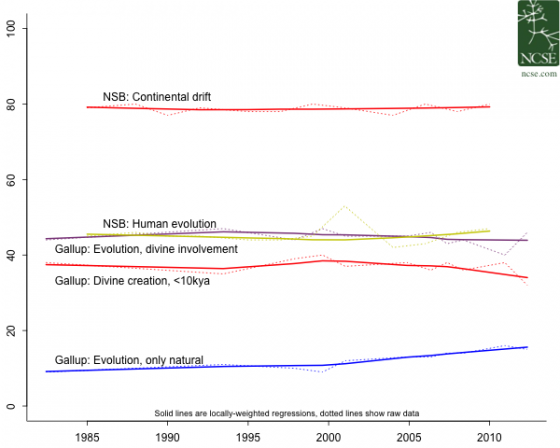
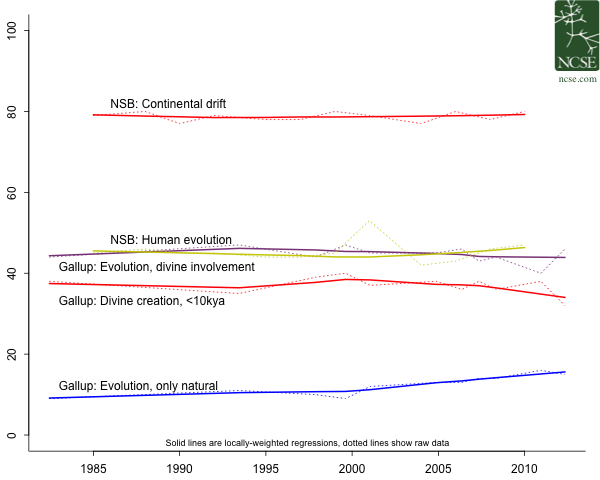
When you break down the polls and question Americans about their acceptance of specific scientific ideas like continental drift and animal evolution, a much higher percentage are NOT creationists
For decades now, the Gallup Poll has surveyed Americans about their belief in evolution and creation. Year in and year out, the numbers seem to remain constant: about 40-45% of Americans appear to be Young-Earth creationists (YEC). The exact phrasing of the question is as follows:
Which of the following statements comes closest to your views on the origin and development of human beings: human beings have evolved over millions of years from other forms of life and God guided this process, human beings have evolved over millions of years from other forms of life, but God had no part in this process, or God created human beings in their present form at one time within the last 10,000 years.
For decades about 44% of the respondents agree to the last answer (YEC), another 37% chose the first answer (theistic evolution, ID creationist), and only 12% favor the second answer (non-theistic evolution). Gallup wrote these questions decades ago before there was much understanding of how the framing of a question can bias the answer, and for decades, they have kept the question the same so comparisons remain consistent. But social scientists know that polls can be very misleading, especially in the way the question is framed to force certain responses. For example, the Gallup poll only gives us three possibilities, and load two of the answers with “God”, which is an obvious bias right from the start. In addition, there is good evidence to suggest that human evolution is the real sticking point, and that most people don’t care one way or another if non-human creatures evolve or not. What if we asked people what they thought about specific scientific ideas, independent of emotional issues like “God” and “humans”?
Continue reading…
comments (26)
by
Donald Prothero, Apr 30 2014
In my 2007 book Evolution: What the Fossils Say and Why it Matters, I detailed the problems with the bizarre view of the earth known as “flood geology.” Originally hatched by George Macready Price, a school teacher with no training or experience whatsoever in geology, he dreamed it up by reading children’s books about geology. Price was a Seventh-Day Adventist, therefore he had to believe in Young-Earth Creationism. Thus, he would create elaborate explanations of how Noah’s flood could explain the entire geological record—or at least the record as portrayed in oversimplified cartoons in kiddie books. If he had ever bothered to go into the field and look directly at the rocks, he might have changed his mind.
Ironically, the entire idea of Noah’s flood explaining the rock record was disproven by creationist geologists themselves. The Noah’s flood model was widely believed before 1795, but in the early 1800s geologists began to look at the rocks of Europe in greater detail, and realized that it could not be explained by one flood or by many floods. By 1830, “flood geology” was completely dead, even though the geologists of the time were all devoutly religious and believed in the Bible. And this all happened decades before Charles Darwin published his ideas in 1859, so in no way did geologists “shuffle the fossils and the strata” to prove evolution, as some creationists claim. Continue reading…
comments (14)
by
Donald Prothero, Feb 26 2014

One of the recurring themes at the Feb. 4 debate between Bill Nye and Ken Ham was Ham’s continuously harping on a supposed distinction between “observational science” (science we can observe in real time) and “historical science” (science that must be inferred from the past). This strange distinction is almost unique to Ken Ham, although I’m sure he borrowed from older creationist writings somewhere, since I remember reading about it when I researched creationism in the 1980s. Nevertheless, Ham kept pounding on it again and again, refusing to talk about any scientific evidence that couldn’t be witnessed in real time.
As many scientists have discussed, this distinction is complete bunk, and only Ken Ham and his followers seem to think that it makes any sense. Naturally, he pounds on this phony, self-serving, artificial distinction because it plays in his favor. Each time Bill pressed him on one point or another, Ham retreated behind his dodge of no one can know anything of “historical” past, then made the ridiculous assertion that the only reliable source of information about the past is the Bible. (Bill was too much of a gentleman to challenge him on this and ask Ken how he knows this. As Ham always says, “Were you there?”). Most of science tells us that the earth is old, that life has evolved, and so on. Ham wants to throw all this information away, so he creates a convenient but ridiculous distinction that serves his purposes—but bears no relation to what real scientists do or think. Continue reading…
comments (16)
by
Donald Prothero, Feb 12 2014
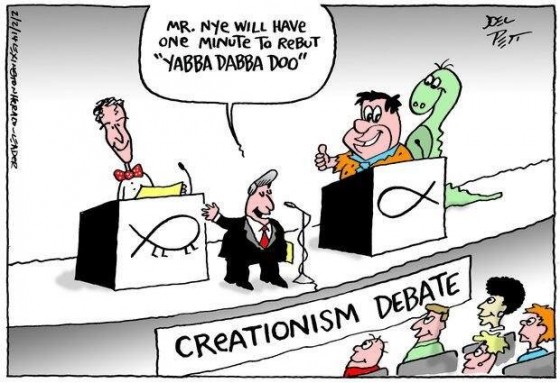
I write this post just a few hours after watching the Ham on Nye “debate” last night. I’m still mulling over the details, and checking on line to see the evolving reactions to the events, but it’s running through my head so much now that it’s time to write it down so I can get back to work. Fittingly, it will post on February 12, Darwin’s 205th birthday. It couldn’t be more appropriate.
Let me start at the beginning. I was at Michael Shermer’s New Year’s Eve party last December 31st. This is not just your average New Year’s Eve party: it’s in Shermer’s magnificent glass-walled view house at the foot of the San Gabriel Mountains with an amazing panorama of the lights of the city below. He had his telescope out on the porch, and we all got a view of the four Galilean moons of Jupiter. The guests include Mr. Deity and “Lucy” (Brian Keith Dalton and Amy Rohren), D.J. Grothe of the James Randi Educational Foundation, lots of scientists including several JPL people, Shermer’s grad students—and Bill Nye. Late in the evening, Bill comes up to me and mentions that he had agreed to debate Ken Ham. He knew I’d beaten Duane Gish back in 1983, and that I was familiar with battling creationism over the past 35 years. After I talked to him and realized that the debate was set and he could not back out, I offered to help him prepare. Then about 3 weeks ago, he emailed me and we made arrangements. He spent a day in Oakland at the National Center for Science Education (NCSE), where a bunch of their staff helped him analyze Ham’s past debates and arguments (they have archives of every creationist out there), and suggest strategies. Since Ham had voluntarily set the debate topic to defend the scientific value and truth of the Bible, Bill was not in the usual dilemma of having to defend and explain complex topics of evolution. Normally, creationists employ the “Gish Gallop” to keep the scientist on the defensive, trying to undo the mistaken ideas and lies the creationist has just said, and replace it with a more complex explanation. Instead, the NCSE staffers recommended that Bill use this to his advantage, and do a “reverse Gish Gallop”: pile on the examples one after another, so that Ham wouldn’t have time or ability to answer them all. Continue reading…
comments (43)
by
Daniel Loxton, Feb 03 2014
Tomorrow, as many of you know, Bill Nye “the Science Guy” will take the stage with Answers in Genesis frontman Ken Ham to debate the topic of evolution. For those of you interested, the event may be watched streaming for free, live at 7 PM Eastern on February 4, 2014.
Are such debates a good idea? As you might gather from the many divergent opinions on Nye’s choice, the answer is far from clear. Too much depends upon the circumstances, format, and participants of the “debate.” Also, it is often argued—and I tend to agree with this argument—that there are figures too cynical to be fruitfully engaged in any format. (My initial gut feeling was that Ham may not be a fair-minded opponent, and that this particular debate may not have been a wise decision for Nye for that reason—though Randy Olson has almost brought me around with this thoughtful post.)
But the wider meta-question is not a new one. I thought it might be interesting to share a decades-old argument in favor of public engagement with fringe ideas and their proponents by a pioneering voice for modern scientific skepticism: Carl Sagan. It reminds me that “debating pseudoscience” is, when you get down to it, what skeptics do.
In December of 1969, a symposium on the topic of UFOs was hosted by the American Association for the Advancement of Science. Organized by Sagan and Thornton Page, it almost didn’t happen at all. For over a year, the symposium faced passionate opposition from scientists who believed that hosting such an exchange would lend inappropriate legitimacy and stage time to the fringe, and all at the expense of the science. “A distinguished scientist once threatened to sic then Vice-President Spiro T. Agnew on me,” Sagan later recalled, “if I persisted in organizing a meeting of the American Association for the Advancement of Science in which both proponents and opponents of the extraterrestrial-spacecraft hypothesis of UFO origins would be permitted to speak.”1
Continue reading…
comments (34)