by
Donald Prothero, Aug 27 2014
In our modern world, we have a strange phenomenon. When polls are conducted about which professions the public considers most trustworthy and useful to society, scientists nearly always come out at or near the top. This poll by the Pew Research Center of 4006 American adults placed them just below the military, doctors, and teachers in terms of trust and their contribution to society. (To no one’s surprise, lawyers were considered the least trustworthy and contributed least to society). This poll by Ipsos of 1018 adults in the UK placed scientists just below doctors and teachers. (Lawyers were not included, so bankers and politicians came out at the bottom in the UK).
Historically, this has long been true. Most people appreciate the huge benefit that science brings to society in terms of the technological advances that make our lives longer and better. And despite the stereotypes, apparently most people still regard scientists as objectively seeking the truth, working hard in their labs, and trying to unravel the secrets of the universe. Unfortunately, the most common stereotypical myth, Hollywood’s “mad scientist out to destroy/ dominate the world” is still pervasive as well. Continue reading…
comments (43)
by
Donald Prothero, Jun 25 2014

The “CUSS-1″ ship, the first ocean drilling vessel, and the prototype for the Glomar Challenger
Every great improvement has come after repeated failures. Virtually nothing comes out right the first time. Failures, repeated failures, are finger posts on the road to achievement. One fails forward toward success.
—Charles Kettering
Honorable errors do not count as failures in science, but as seeds for progress in the quintessential activity of correction.
—Stephen Jay Gould
Most people hear only about the successful experiments in science. What is usually not reported is the fact that for every scientific success, there may be numerous failures and false leads and blind alleys. Most people would find this discouraging, but scientists learn early in their careers that one has to expect a number of failed experiments that can lead us to better ideas. As philosophers of science pointed out long ago, science is about testing and falsifying hypotheses. No number of positive or consistent observations can ever prove a statement true (e.g., “all swans are white”) but a single contradictory observation (e.g., the Australian black swan) can easily prove the statement false. Likewise, every failed experiment points the scientist toward a new direction or a new hypothesis or new experiment, which may eventually prove fruitful. Science is a process of trial and error, and scientists need patience, persistence and determination to reach good results after many letdowns.
Nearly every field in science can point to examples of this. Even after 35 years of doing magnetic stratigraphy, not every locality where I have done paleomagnetic sampling produced good results. The data from those unsuccessful studies are sitting in my file cabinets and the hard drive of the lab computer, but I won’t bother working on them further or try to report them in a publication. Occasionally, I’ll mention in print that a particular area (like the Chadron Formation in the Big Badlands, or the Titus Canyon Formation near Death Valley) produced no good paleomagnetic results, but further discussion is usually not worth writing up.
Likewise, looking for vertebrate fossils is usually a frustrating and unsuccessful exercise. Most paleontologists must spend days or weeks in a field to find anything, and sometimes several field seasons can go by with no worthwhile results. My graduate advisor Malcolm McKenna spent several years collecting his dissertation area at Four Mile Creek in northwestern Colorado before finding good specimens. Louis and Mary Leakey spent decades collecting in Olduvai Gorge, Tanzania, and found plenty of Pliocene-Pleistocene pigs and antelopes and elephants, but not a signal human fossil until their remarkable find of “Zinjanthropus” (now Paranthropus) boisei in 1959. But if paleontologists were not so determined and dedicated, there would be few fossils in museums for us to study.
Continue reading…
comments (2)
by
Donald Prothero, Apr 22 2014
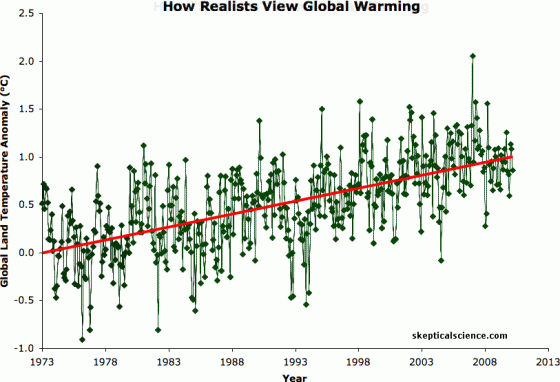
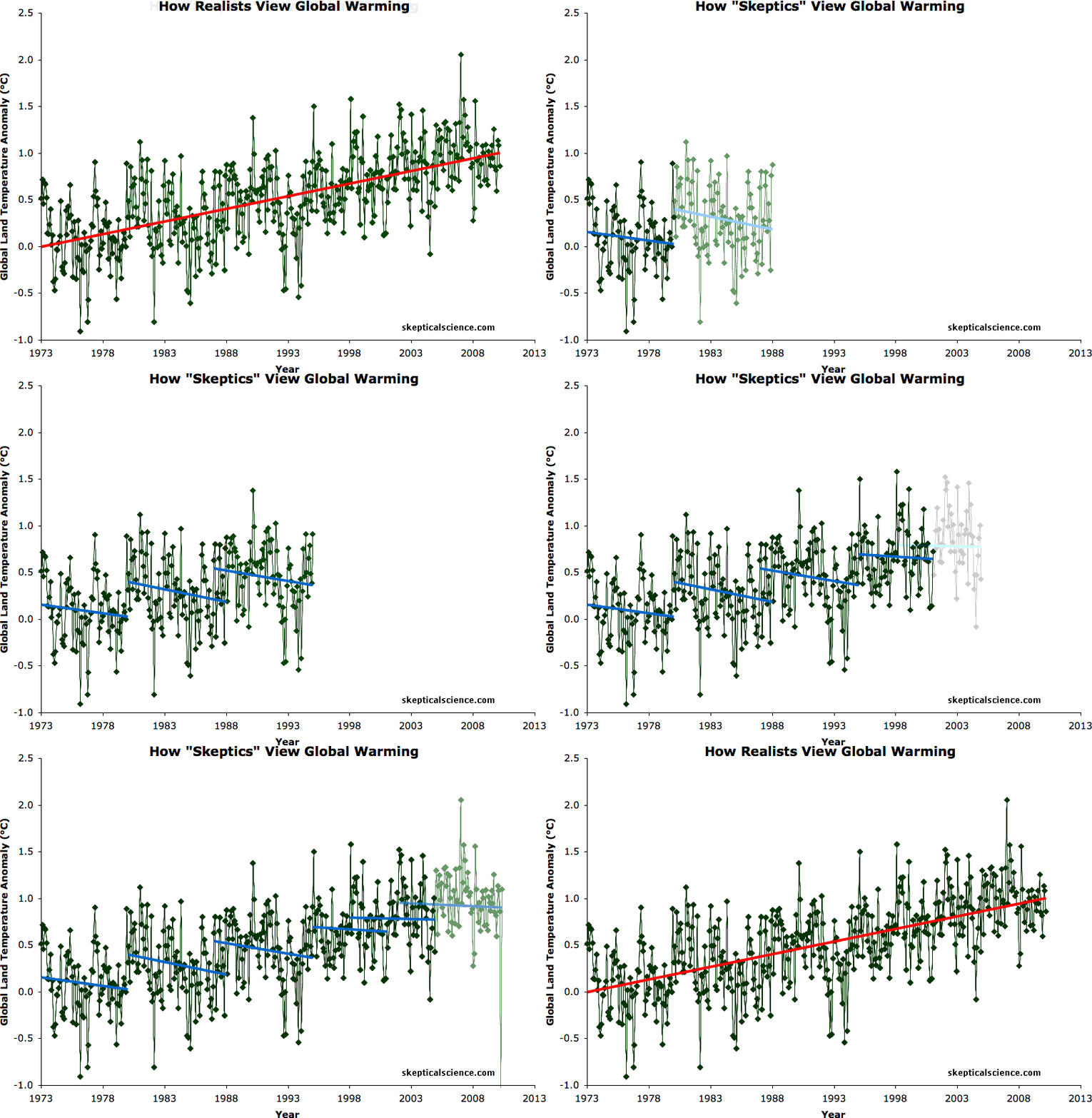
Any data set can be falsely manipulated to distort its meaning. For example, if you just plot short segments of the noisy climate data set, you could imagine a series of short-term “cooling” trends (click on the image). But statistically the only valid approach is to average over the long term, when there is undeniable warming taking place
In the spirit of Earth Day, which happens today, I’ll blog about another important ecological topic: the alleged “global warming pause”.
About a year ago, I wrote a post about the climate-denier myth that “it’s been cooling since 1998″. As the post pointed out, this is based on cherry-picking the anomalously warm year of 1998 (atypical because it was an extraordinary El Niño year that brought a lot of heat from the tropical oceans into the atmosphere), then deliberately picking one or two years following and calling that “cooling”.
As the climate deniers have been called out about this lie, they’ve shifted the goalposts, and made the claim that the global warming has “paused” since 1998. As reported in Mother Jones, Fox News began playing this meme over and over again in 2012, so that soon the regular media were echoing their meme as well. But is it true? NO! Continue reading…
comments (59)
by
Donald Prothero, Oct 16 2013

A review of The Hockey Stick and the Climate Wars: Dispatches from the Front Lines
by Michael E. Mann
(Columbia University Press, New York, 395 pp., 2012)
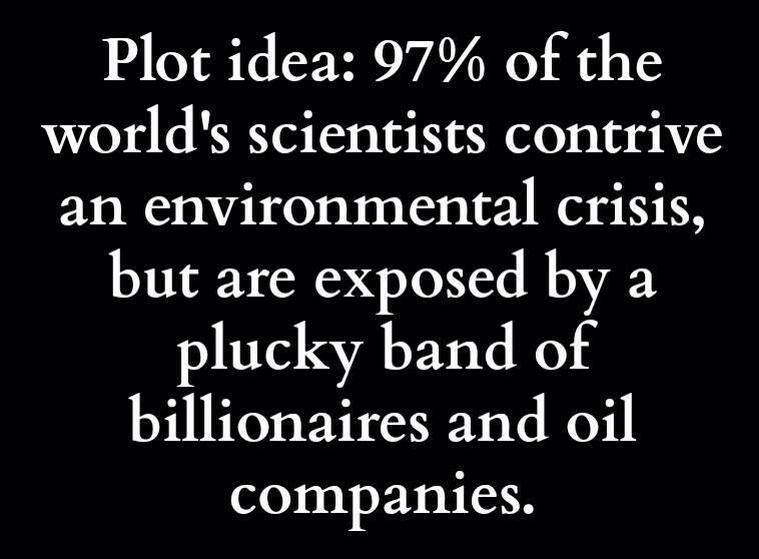
The topic of global climate change has become one of the hottest global issues for over a decade now, figuring prominently in U.S. politics, and leading to many international conferences on how to contain it. As a scientific debate, the facts were resolved over a decade ago. Survey after survey over the past decade have shown that roughly 95-99% of scientists who publish peer-reviewed research in climate change agree that global climate is changing rapidly and that humans are to blame. This is a level of consensus in science similar to that supporting gravity, plate tectonics, big bang cosmology, quantum physics—or evolution. Yet for reasons having nothing to do with science (i.e., religion or ideology), there are powerful vested interests in the United States that don’t like the “inconvenient truths” of evolution or big bang cosmology (creationists) or climate change (libertarians and free-market conservatives, backed by the fossil fuel industry). They are determined to fight scientific consensus by any means necessary. In contrast to Canada, or any major industrialized nation in Europe or in eastern Asia (including Japan, South Korea, China, and others), the U.S. is the only nation where science deniers (creationists and climate deniers) comprise any significant part of the population, and have a lot of influence in a major political party, so they can prevent any political action on the issue. Continue reading…
comments (34)
by
Donald Prothero, May 22 2013
The saddest aspect of life right now is that science gathers knowledge faster than society gathers wisdom
—Isaac Asimov
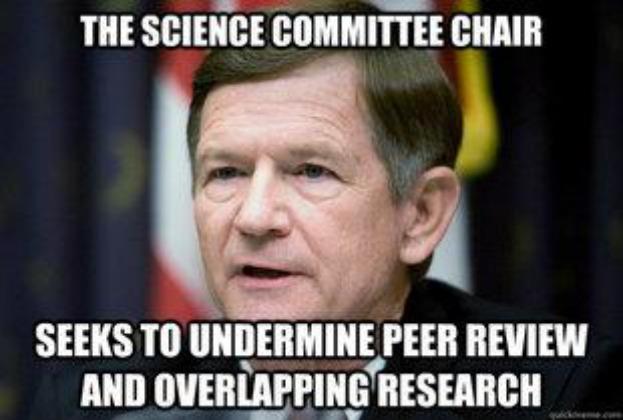
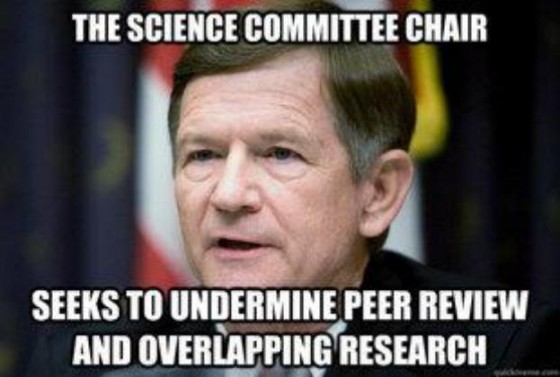
A few weeks ago, we heard in the news the chilling and alarming statement that Rep. Lamar Smith (R-TX), chair of the House Science and Technology Committee, wants to subject all the scientific research grants of the National Science Foundation (NSF) to political scrutiny. No longer was it sufficient that the NSF conduct peer review of grants by experts in the field to determine whether they are worthy of funding. No, the House Committee has decided that they are better judges of good science that the scientific community itself, and they ought to be able to override the decisions of scientists who work in the field.
We’ve seen this kind of political interference in science before, but never at such a high level. Even more disturbing, the GOP members of the House Science and Technology Committee are not the kind of people that most of us would want judging the quality of science. They are nearly all science deniers of one sort or another. This committee includes such luminaries as Rep. Paul Broun of Georgia (an M.D., even!), who said (in a recent speech at the Liberty Baptist Church Sportsman’s Banquet):
“God’s word is true. I’ve come to understand that. All that stuff I was taught about evolution, embryology, Big Bang theory, all that is lies straight from the pit of hell. It’s lies to try to keep me and all the folks who are taught that from understanding that they need a savior. There’s a lot of scientific data that I found out as a scientist [note: Broun is NOT a real scientist] that actually show that this is really a young Earth. I believe that the Earth is about 9,000 years old. I believe that it was created in six days as we know them. That’s what the Bible says. And what I’ve come to learn is that it’s the manufacturer’s handbook, is what I call it. It teaches us how to run our lives individually. How to run our families, how to run our churches. But it teaches us how to run all our public policy and everything in society. And that’s the reason, as your congressman, I hold the Holy Bible as being the major directions to me of how I vote in Washington, D.C., and I’ll continue to do that.”
Continue reading…
comments (73)
by
Donald Prothero, Apr 17 2013
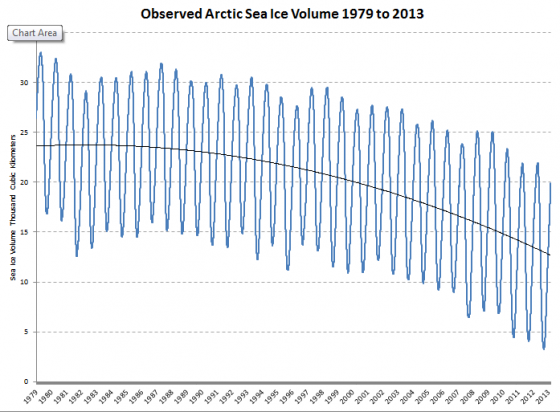
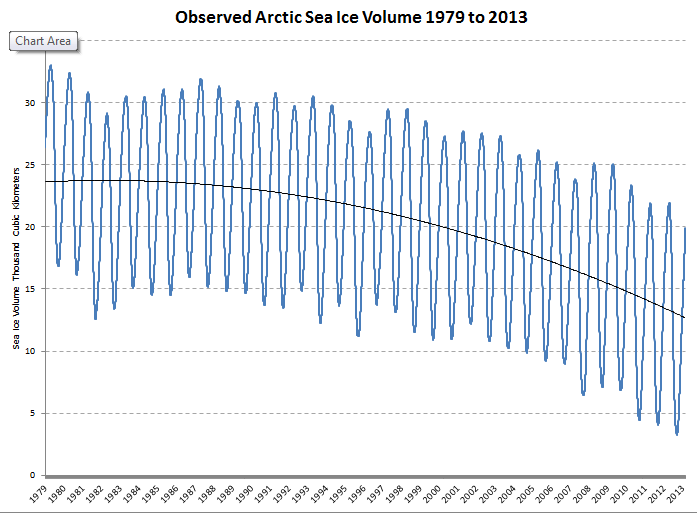
The rapid disappearance of the Arctic sea ice, with an averaged curve (black line) fitted to the annual cyclic variation of seasonal ice (fluctuating blue curve).
The year 2012 and now early 2013 have been an unending litany of bad climate news. After a record-breaking year of heat and drought in North America, and with devastating Superstorm Sandy, and record heat and fires in Australia, the year 2012 ended up being the ninth hottest year on record despite a strong La Niña cycle that should have made it a lot cooler. Once the current La Niña cycle ends, you can expect the next few years to blast past the previous global temperature record of 2010. As it is, nine of the ten hottest years on record were in the last decade—only the record-breaking El Niño year of 1998 didn’t occur in the window between 2002 and 2012.
Even more alarming were the weekly reports about the incredibly fast loss of our global ice volume, from mountain glaciers to the Greenland and Antarctic continental ice sheets. Most serious of all, however, is the record melting of the Arctic ice. Last summer, the Arctic ice cap shrank to the lowest level ever measured, and even the winter ice pack was the fifth smallest ever measured. And the news just came in that the melting rate of the Antarctic ice cap is the highest ever recorded. If anything will cause the rapid rise of sea level, it will be the melting of these ice sheets. Then we’ll see not only low-lying countries disappear, but more storms like Superstorm Sandy, whose storm surge will reach much further inland with a higher sea level base. Continue reading…
comments (133)
by
Brian Dunning, Jan 03 2013
 Anyone who has ever pointed out that a scientific consensus exists on a certain matter has probably been meet with laughter and derision. The word consensus has practically become a punchline. It is reminiscent of the famous corollary to Godwin’s Law which states that the first person to mention Nazis has automatically lost the argument; so it frequently goes with the first person to mention consensus. So many highly visible personalities deny and deride scientific consensus that the term has, in popular usage, become synonymous with a fatally weak argument. Continue reading…
comments (44)
by
Donald Prothero, Nov 14 2012
The “end of the world” allegedly predicted by the Mayan calendar in December 2012 may be a myth, but 2012 had no shortage of catastrophes. We had the warmest year in history in North America, with record-breaking heat waves through much of the summer, and drought conditions approaching those of the Dust Bowl years. A July heat wave melted 97% of the surface of the Greenland ice sheet, the worst melting since satellite monitoring began 30 years ago. Arctic sea ice cover in September was at an the all-time low, beating the record set only back in 2007. 2011 was not much better, with Hurricane Irene flooding the Northeast, a large number of killer tornadoes (including deadly storms in Missouri and Alabama), 500-year floods in Nashville and Duluth, and severe wildfires all over the parched Rocky Mountains. It seems that the news is full of one unprecedented weather event after another, and those jokes about snowy winters a few years ago seem lame when most of the U.S. population sweltered through the heat waves of 2012. Continue reading…
comments (57)
by
Donald Prothero, Oct 24 2012
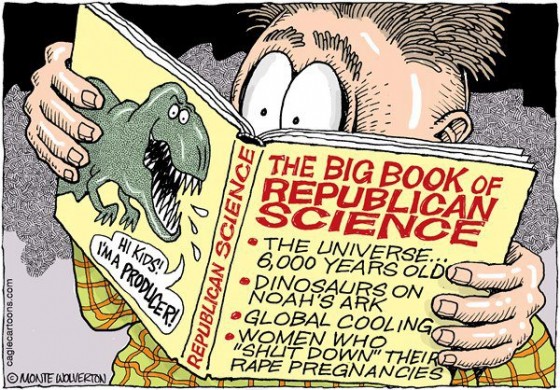
The news recently has been full of shocking and disconcerting quotes from the members of Congress. The most outrageous is by Rep. Paul Broun of Georgia (an M.D., even!), who said (in a recent speech at the Liberty Baptist Church Sportsman’s Banquet):
“God’s word is true. I’ve come to understand that. All that stuff I was taught about evolution, embryology, Big Bang theory, all that is lies straight from the pit of hell. It’s lies to try to keep me and all the folks who are taught that from understanding that they need a savior. There’s a lot of scientific data that I found out as a scientist [note: Broun is NOT a real scientist] that actually show that this is really a young Earth. I believe that the Earth is about 9,000 years old. I believe that it was created in six days as we know them. That’s what the Bible says. And what I’ve come to learn is that it’s the manufacturer’s handbook, is what I call it. It teaches us how to run our lives individually. How to run our families, how to run our churches. But it teaches us how to run all our public policy and everything in society. And that’s the reason, as your congressman, I hold the Holy Bible as being the major directions to me of how I vote in Washington, D.C., and I’ll continue to do that.”
When he heard this statement, Bill Nye said:
“Since the economic future of the United States depends on our tradition of technological innovation, Representative Broun’s views are not in the national interest,” Nye told The Huffington Post in an email. “For example, the Earth is simply not 9,000 years old,” he continued, contradicting a remark made by Broun later in the video. “He is, by any measure, unqualified to make decisions about science, space, and technology.”
Continue reading…
comments (55)
by
Donald Prothero, Jun 27 2012

This was the first in a series of planned billboards that created real problems for Heartland Institute.
The Heartland Institute, a libertarian think-tank based in Chicago, has never been afraid of controversy. It was founded in 1984, originally to push free-market and libertarian causes. Heartland spent its early years as an apologist for the tobacco industry, fighting to deny or obscure the scientific evidence for the dangers of smoking and of second-hand smoke, and derail public health policies to protect people from smoking and smokers. In recent years, it has become more famous for being a hotbed of global-warming denialism, sponsoring conferences where all the “big names” of denialism get together and preach to the choir. They are also famous for their anti-environmental efforts across the board, especially with the debate over fracking, the safety of coal mining, and other controversial practices. In this regard, they are not too different from some of the other “think-tanks” that push free market and libertarian policies, heavily supported by private industry and right-wing foundations.
But the business of pushing unpopular agendas like smoking is all about credibility and PR, and making your institute appear to be a serious defender of some worthy cause, not a hotbed of crazies. Thus, perception is everything. And it’s clear that in recent months, Heartland has “jumped the shark” and is now on a downward death spiral, as funding dries up and even their former supporters refuse to have their names associated with it. The problem started with their almost yearly conferences on climate change, which became more and more extreme so that even many mainstream climate-change deniers refused to participate. By 2006, ExxonMobil stopped funding them, and tried to distance themselves from the Heartland reputation as a bastion of loonies. Still, Heartland kept promoting their causes, and kept their climate-change conferences going nearly every year. Continue reading…
comments (22)