Skepticblog
About Michael Shermer
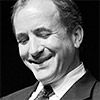
Dr. Michael Shermer is the Founding Publisher of Skeptic magazine, the monthly "Skeptic" columnist for Scientific American, and author of Why people Believe Weird Things, an exploration into a variety of strange ideas, groups and cults. A psychologist, professor and historian of science, Dr. Shermer was also the co-producer and co-host of the Fox Family television series, Exploring the Unknown. Dr. Shermer has made countless appearances on television including, Oprah, Larry King Live, The Colbert Report, Dateline, 20/20, The History Channel, A&E, The Discovery Channel, and PBS as a skeptic of weird and extraordinary claims.
RSS feed for this author
www.michaelshermer.com
www.skeptic.com
Subjects
aliens alternative medicine atheism autism belief bigfoot Brian Dunning CAM Carl Sagan climate change conspiracy theories Creation creationism critical thinking cryptozoology denialism dinosaurs Dr. Kiki earthquakes economics education environment ethics evolution fossils geology Ghost Hunting ghosts global warming God homeopathy intelligent design james randi journalism media medicine michael shermer morality nasa paleontology paranormal politics pseudoscience Psychics psychology religion science science denialism scope SETI Shermer skeptical history skepticism skeptoid Skeptologists TV ufo ufos vaccines videoRecent Comments
- Daniel Loxton commented on A Fond Farewell to Skepticblog at 1:25 pm, September 18, 2014
- markx commented on A Fond Farewell to Skepticblog at 8:52 pm, September 17, 2014
- Thomas commented on False Equivalence at 11:44 am, September 15, 2014
- John Greg commented on A Fond Farewell to Skepticblog at 2:10 pm, September 13, 2014
- tmac57 commented on A Fond Farewell to Skepticblog at 10:39 am, September 13, 2014
Read posts by author:
Leaving Las Vegas … Rich
Report from the Front Lines at TAM and Freedom Fest
By “rich” I mean intellectually, of course, because as all skeptics know, the laws of probability are precisely employed by all Las Vegas casinos to insure that if you play long enough the money in your pocket will end up in their coffers. It is not for nothing that it is called Lost Wages.
Actually, there are two ways to win at gambling. You can do it the way I did after the final session at TAM Sunday: play for a brief period of time and quit when you are ahead. I started with $200 at a $5 minimum Blackjack table. For around 20 minutes I bounced around between $150 and $250 in chips artfully stacked in front of me as I pretended to be a big spender. The inevitable losing streak then kicked in and I was suddenly down below $50, then clawed my way back up to $228 when it was time to go, saving myself from the over-confidence bias that would have, in time, left me with nothing but green cloth beneath my empty palms. (The other way to win at gambling in Las Vegas? Be the owner of a casino.) (continue reading…)
comments (17)
How to Learn to Think Like a Scientist
(Without Being a Geek)
Or: What it was Like Teaching a Course in Skepticism 101?

On March 31, 2011, I debated Deepak Chopra at Chapman University on “The Nature of Reality” that also featured Stuart Hameroff, Leonard Mlodinow, and several other commentators, all choreographed by the Chancellor of Chapman University, mathematician Daniele Struppa. In the greenroom before the debate Dr. Struppa was reviewing my bio and noted that I am an adjunct professor at Claremont Graduate University and made a comment that I should be an adjunct professor at Chapman as well. I said something like “sure, why not?” and when he introduced me on stage he said something about how I might also one day teach there. Daniele said I could teach anything I want as part of their Freshman Foundations Courses, so I suggested a course on Skepticism 101, or how to think like a scientist (without being a geek). I taught it the Fall semester of 2011 to 35 incoming Freshman students and it was a blast.
During the semester I hatched the idea that since the Skeptics Society is a 501(c)(3) nonprofit educational organization specializing in science education, that we should organize all the course materials that professors and teachers around the world are already utilizing. That is, as I was developing my own course materials I remembered all the requests we had received over the years at the Skeptics Society from educators to reprint articles from Skeptic magazine or use videos of our Distinguished Science Lecture Series at Caltech. There are, in fact, hundreds and hundreds (maybe thousands) of such courses that go under various names that involve skepticism, science and pseudoscience, science and the paranormal, psychology and parapsychology, the psychology of belief, the history of science, the philosophy of science, science studies, critical thinking, and the like. As I went digging through our own webpage Skeptic.com and surfed the Net for other teacher’s webpages in search of good teaching materials, we thought it might be good to invite people to submit their course syllabi, lectures, Powerpoint and Keynote presentations, videos, student projects, reading lists, and the like, which we just launched last week.
EXPLORE THE SKEPTICISM 101 RESOURCE CENTER
Thanks to the support of my good friend Tyson Jacobsen I was able to hire an outstanding graduate student, Anondah Saide, to organize the Skepticism 101 program for us, which began with her TAing the Skepticism 101 course at Chapman University. Anondah was one of my graduate students at Claremont Graduate University who conducts research into the sociology of pseudoscience and the paranormal, and she has a deep interest in education and how to teach students to think critically about the paranormal and the supernatural, so she was a perfect fit for the class and this program. (continue reading…)
comments (26)The Reality Distortion Field
Steve Jobs’s modus operandi of ignoring reality
is a double-edge sword
Robert Friedland was a long-haired, sandal-wearing, spiritual-seeking proprietor of an apple farm commune and student at Reed College when he met Steve Jobs in 1972 and taught the future Apple computer founder a principle called the “reality distortion field” (RDF). Macintosh software designer Bud Tribble recalled, “In his presence, reality is malleable. He can convince anyone of practically anything.” And yet the blade could cut two ways: “It was dangerous to get caught in Steve’s distortion field, but it was what led him to actually be able to change reality.” Another Mac software designer named Andy Hertzfeld said, “The reality distortion field was a confounding mélange of a charismatic rhetorical style, indomitable will, and eagerness to bend any fact to fit the purpose at hand.” The first Mac team manager Debi Coleman said Jobs “reminded me of Rasputin. He laser-beamed in on you and didn’t blink. It didn’t matter if he was serving purple Kool-Aid. You drank it.” And yet when the power was properly channeled, “You did the impossible, because you didn’t realize it was impossible.”
The RDF is an extreme version of what the psychologist Daniel Kahneman calls a “pervasive optimistic bias” in his 2011 book Thinking, Fast and Slow (Farrar, Straus and Giroux). “Most of us view the world as more benign than it really is, our own attributes as more favorable than they truly are, and the goals we adopt as more achievable than they are likely to be.” For example, only 35 percent of small businesses survive in the U.S., but when surveyed 81 percent of entrepreneurs assessed their odds of success at 70 percent, and 33 percent went so far as to put it at 100 percent! “One of the benefits of an optimistic temperament is that it encourages persistence in the face of obstacles,” Kahneman notes, while also citing study in which 47 percent of inventors “continued development efforts even after being told that their project was hopeless, and on average these persistent (or obstinate) individuals doubled their initial losses before giving up.” Failure may not be an option in the minds of entrepreneurs, but it is all too frequent in reality, which is why another bias called “loss aversion” is felt by most. Thus, Jobs’s success story is also an example of a selection bias whereby those who failed tend not to have biographies. (continue reading…)
comments (44)A Weekend of Woo (Or why I love the Esalen Institute)
For the forth time in my life I journeyed north on Pacific Coast Highway along the ragged California coast line north of San Simeon and the Hearst Castle where the road turns twisty and the cliffs bend vertical. The Esalen Institute is nestled on the ocean side of the highway atop some bluffs dotted with buildings that include yoga rooms, Yurts, Spartan housing overlooking the ocean, a soup kitchen-like cafeteria serving spectacularly healthy food (lots of Tofu and veggies, no tri-tips or ribs), and workshops catering to just about every belief ever investigated and found wanting in the pages of Skeptic magazine.
Nevertheless, I loved my time there once again, not only for the breathtaking scenery and unprecedented views, or the invigorating cycling and hiking, or the natural hot springs pouring out of the mountain and into elegantly designed hot tubs (clothing optional, and most opt to go without), but for the apparent incongruity made congruous when we consider our mission as skeptics to take our message of science and critical thinking to those who need to hear it most.
My workshop was entitled “Science, Spirituality, and the Search for Morality and Meaning.” First, I must say that the 24 participants in my workshop were already as skeptical as one might find at one of our Sunday Caltech lecture series meetings and dinners. All were well-read in the sciences and humanities to the point that I learned as much as I taught, and the ensuing conversations both during and after the lectures, along with at the meals, were exceptional. (continue reading…)
comments (25)The Unknown Unknowns
This review of Ignorance: How it Drives Science by Stuart Firestein (Oxford University Press, May 2012, ISBN 13: 97801-998-28074) was originally published in Nature, 484, 446–447 (26 April 2012) as “Philosophy: What we don’t know.”
At a press conference on February 12, 2002, the United State Secretary of Defense Donald Rumsfeld employed epistemology to the explain U.S. foreign entanglements and their unintended consequences: “There are known knowns. There are things we know we know. We also know there are known unknowns. That is to say, we know there are some things we do not know. But there are also unknown unknowns, the ones we don’t know we don’t know.”
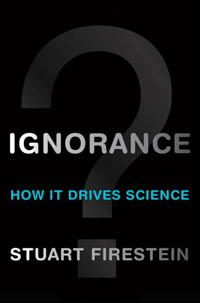
It is this latter category especially that is the focus of Stuart Firestein’s sparkling and innovative look at ignorance, and how it propels the scientific process forward. Firestein is Professor and Chair of the Department of Biological Sciences at Columbia University, where he teaches a wildly popular course on ignorance, inviting scientists in as guest speakers to tell students not what they know but what they don’t know, and even what they don’t know that they don’t know. (Would you rather earn an A or an F in a class called “Ignorance”?, he muses.) This is a slim volume about a fat topic, but Firestein captures the essence of the problem by contrasting the public’s understanding of science as a step-wise systematic algorithm of grinding through experiments that churn out data sets to be analyzed statistically and published in peer-reviewed journals after a process of observation, hypothesis, manipulation, further observation, and new hypothesis testing, with the Princeton University mathematician Andrew Wiles’ description of science as “groping and probing and poking, and some bumbling and bungling, and then a switch is discovered, often by accident, and the light is lit, and everyone says, ‘Oh, wow, so that’s how it looks,’ and then it’s off into the next dark room, looking for the next mysterious black feline” (p. 2), in reference to the old proverb: “It is very difficult to find a black cat in a dark room. Especially when there is no cat.” (continue reading…)
comments (22)Atheist Nation
Where in the world are the atheists? That is, in what part of the globe will one find the most people who do not believe in God? Answer: East Germany at 52.1%. The least? The Philippines at less than 1%. Predictably, strong belief shows a reverse pattern: 84% in the Philippines to 4% in Japan, with East Germany at the second lowest in strong belief at 8%. Not surprising, those who believe in a personal God “who concerns himself with every human being personally” is lowest in East Germany at 8% and highest in the Philippines at 92%.
These numbers, and others, were collected and crunched by Tom W. Smith of the National Opinion Research Center (NORC) at the University of Chicago, in a paper entitled “Beliefs About God Across Time and Countries,” produced for the International Social Survey Programme (ISSP) and released on April 18, 2012. Smith writes: “Countries with high atheism (and low strong belief) tend to be ex-Socialist states and countries in northwest Europe. Countries with low atheism and high strong belief tend to be Catholic societies, especially in the developing world, plus the United States, Israel, and Orthodox Cyprus.”
Many religious scholars invoke the “secularization thesis” to explain lower religiosity in Northern European countries (compared to the United States) in which mass education, especially in the sciences, coupled to the fact that governments do what religions traditionally did in the past in taking care of the poor and needy. With a tight social safety net religions simply fall into disuse; with a porous social safety net people fall through the cracks and are picked up by religions. Other scholars have suggested a “supply side” explanation for the difference between the U.S. and Europe, in which churches and religions in America must compete for limited resources and customers and thus have ratcheted up the quality of religious products and services: mega churches with rock music, baby sitting, BBQs, and even free parking! Smith seems to find evidence of both forces at work, noting that “In the case of Poland, it appears that its strong Catholicism trumps the secularizing influence of Socialism,” whereas elsewhere in the world “there is also evidence that religious competition and/or religious conflict may stimulate higher belief.” (continue reading…)
comments (38)Shermer in Seminary School
My weekend at the New Orleans Baptist Seminary discussing God, religion, and the afterlife
On Friday, April 13, 2012 in the chapel of the New Orleans Baptist Seminary I debated the Liberty University philosopher and theologian Gary Habermas on the question: “Is There Life After Death?” I went first. I stated that since Gary is taking the affirmative I’m suppose to defend the negative, but in fact when it comes to the afterlife, “I’m for it!” Tellingly, that line didn’t get the usual laugh it engenders in audiences, but then in seminary school the afterlife is a deadly serious subject. I began with this thought experiment:
Imagine yourself dead. What picture comes to mind? Your funeral with a casket surrounded by family and friends? Complete darkness and void? In either case you are still conscious and observing the scene.
I then outlined the problem we all have in thinking about life after death: we cannot envision what it is like to be dead any more than we can visualize ourselves before we were born, and yet everyone who ever lived has died so death is inevitable. This leads to either depression or humor. I prefer the latter. For example, Steven Wright: “I intend to live forever—so far, so good.” Or Woody Allen: “It’s not that I’m afraid to die. I just don’t want to be there when it happens.”
Of course, you won’t be there when it happens because to experience anything you must be conscious, and you are not conscious when you are dead. I then outlined four theories of life after death, gleaned from my recent Scientific American column based on Stephen Cave’s marvelous new book, Immortality, which I highly recommend reading. (continue reading…)
comments (70)Are you an Atheist or Agnostic?
Recently my friend and colleague in science and skepticism Neil deGrasse Tyson, issued a public statement via BigThink.com in which he stated that he dislikes labels because they carry with them all the baggage that the person thinks they already know about that particular label, and thus he prefers no label at all when it comes to the god question and simply calls himself an agnostic.
The Believing Brain
by Michael Shermer
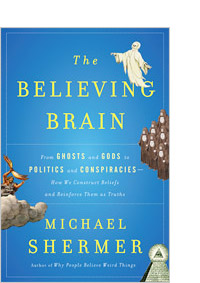
In this book, I present my theory on how beliefs are born, formed, nourished, reinforced, challenged, changed, and extinguished. Sam Harris calls The Believing Brain “a wonderfully lucid, accessible, and wide-ranging account of the boundary between justified and unjustified belief.” Leonard Mlodinow calls it “a tour de force integrating neuroscience and the social sciences.”
I have already written about this many times over the decades, and my 1999 book How We Believe outlines in detail why I too hate labels. In fact, in my later book, The Mind of the Market, I explained why I also do not like the label “libertarian” because people automatically think this means believing something that I very likely do not believe (e.g., that humans are by nature purely selfish, that we have no moral obligation to help others in need, that greed is the only motive that counts in business, and that Ayn Rand was actually the Messiah), and instead I prefer to go issue by issue. Nevertheless, the label “libertarian” and “atheist” stick, and as I explained in my latest book, The Believing Brain, I’ve largely given up the anti-label struggle and just call myself by these labels. In effect, what I once thought of as intellectual laziness on the part of my interlocuters who did not seem to want to bother to actually read my clarifications and what, exactly, I do believe about this or that issue, I now see as the normal process of cognitive shortcutting. Time is short and information is vast. Most of the time our brains just pigeonhole information into categories we already know in order to move on to the next problem to solve, such as why not one Mexican restaurant band I have ever asked seems to know one of the greatest Spanish pieces ever produced: Malagueña. It’s a riddle wrapped in a mystery inside a tortilla. (continue reading…)
comments (352)Reason Rally Rocks
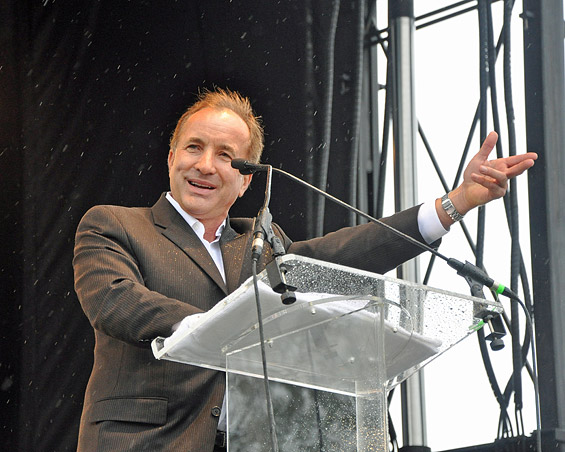
Yours truly, leading the Reason Rally Cheer (photo by John Welte)
March 24, 2012 marked the largest gathering of skeptics, atheists, humanists, nonbelievers, and “nones” (those who tick the “no religion” box on surveys) of all stripes on the Mall in Washington, D.C., across from the original Smithsonian museum. Crowd estimates vary from 15,000 to 25,000. However many it was, it was one rockin’ huge crowd that voiced its support for reason, science, and skepticism louder than any I have ever heard. Anywhere. Any time. Any place. It started raining just as the festivities gathered steam late morning, but the weather seemed to have no effect whatsoever on the enthusiasm and energy of the crowd…or the speakers and performers. The organizer and host David Silverman and his posse of tireless staff and volunteers pulled it off without a hitch. Organizing big events can be an organizational nightmare, but they did it, marking what I hope is the first of many consciousness raising events in the civil rights movement for equal treatment for us nonbelievers and skeptics. (continue reading…)
comments (42)
It is too soon to tell what the motive was behind the accused James Holmes’ mass murder in a movie theater in Aurora, Colorado, especially now that he has stopped talking to the authorities in charge of his case. Reports about his personality, thoughts, and behaviors from friends, fellow students, professors, and the police are conflicting. He was smart, brilliant in fact. No, he wasn’t; he was a sub-standard student who dropped out of his doctoral program at the University of Colorado after failing a preliminary exam. He was a quiet man who said nothing to indicate he was on the verge of cracking. Also not true; he left an incoherent and rambling voice message on the phone service of a gun club he wanted to join, the owner of which noted: “It was this deep, guttural voice, rambling something incoherent. I thought, ‘What is this idiot trying to be?’.” He rigged his apartment with explosive devices but then warned the police about them after his capture. Initial reports described the event as spontaneous and random, but he mailed a notebook to his psychiatrist at his university describing in detail with diagrams precisely what he (pre)planned to do.
It may be months before we have any clue to his mind and motive. And short of something obvious like a brain tumor pressing against his amygdala (the brain’s emotion center)—similar to that in the brain of Charles Whitman, the University of Texas bell tower shooter who in 1966 killed 14 people and wounded 49, including himself, after leaving a note to authorities to autopsy his brain because he felt there was something wrong—we may never know the motive behind James Holmes murderous actions.
We do know something for certain, however, and that is that this will happen again…and again and again. The reason is (continue reading…)
comments (436)