by
Donald Prothero, Oct 09 2013

What did Adam and Eve never have, yet they gave two of them to each of their children?
Answer: parents
—Old children’s riddle
A classic example of an untestable theory to explain nature was the “Omphalos” hypothesis of Philip Henry Gosse. He was a well-respected naturalist in early nineteenth-century England who had written best-selling books about natural history. He was also a very devout member of a Puritanical sect called the Plymouth Brethren. As a good naturalist, Gosse was finding more and more evidence that life had evolved (long before Darwin), but as a Biblical literalist, he felt obligated to follow creationism. Gosse resolved his problems by publishing Omphalos: An Attempt to Untie the Geological Knot in 1857, just two years before Darwin’s book was published. The curious title omphalos means “bellybutton” or “navel” in Greek, and refers to the common theological conundrum of the day: if Adam and Eve were specially created and did not have human parents (and therefore no umbilical cord), did they have a navel or bellybutton? Many religious artists avoided this issue by painting Adam and Eve with a fig leaf not only over their genitalia, but also over their midriffs. Gosse’s answer was yes, of course Adam and Eve had navels. According to Gosse, God created nature to look as if it had a history, to look as if it had evolved, but in reality it was created quite recently. In order for the world to be “functional” God would have created the earth with mountains and canyons, with trees that have growth rings, and with Adam and Eve with a navel. No evidence that indicates the presumed age of the earth or events in the past can be taken at face value. In this manner, Gosse felt that he had solved his own dilemmas about the fact that nature appears to have evolved, yet this solution allowed him to retain his creationist beliefs.
Continue reading…
comments (33)
by
Donald Prothero, Aug 28 2013
A review of Darwin’s Doubt: The Explosive Origin of Animal Life and the Case for Intelligent Design by Stephen Meyer (HarperCollins, New York, 498 pp.)
In everything the prudent acts with knowledge, but a fool flaunts his folly.
—Proverbs 13:16
Ignorance more frequently begets confidence than does knowledge.
—Charles Darwin, The Descent of Man
The fool doth think he is wise, but the wise man knows himself to be a fool.
—William Shakespeare, As You Like It
The Dunning-Kruger effect is a well-known phenomenon in psychology first named in 1998, but it has been recognized since before the Bible and Shakespeare. In a nutshell, it is (as Bertrand Russell put it)
”The trouble with the world is that the stupid are cocksure and the intelligent are full of doubt”. There is also another well-known psychological phenomenon: motivated reasoning. Our brains have many blind spots in them that allow us to reconcile the real world with the world as we want it to be, and reduce the clash of cognitive dissonance. The most familiar of these is confirmation bias, where we see only what we want to see, and ignore or forget anything that doesn’t fit our preferred world-view. When this bias emerges in argument, it takes the form of cherry-picking: finding a few facts out of context that seem to support what we want to believe, and ignoring everything else that contradicts what we are trying to promote.
The entire literature of creationism (and of its recent offspring, “intelligent design” creationism) works entirely on that principle: they don’t like any science that disagrees with their view of religion, so they pick tiny bits out of context that seem to support what they want to believe, and cherry-pick individual cases which fits their bias. In their writings, they are legendary for “quote-mining”: taking a quote out of context to mean the exact opposite of what the author clearly intended (sometimes unintentionally, but often deliberately and maliciously). They either cannot understand the scientific meaning of many fields from genetics to paleontology to geochronology, or their bias filters out all but tiny bits of a research subject that seems to comfort them, and they ignore all the rest. Continue reading…
comments (4)
by
Donald Prothero, Jul 31 2013
A Review of Among the Creationists: Dispatches from the Anti-Evolutionist Front Lines,
by Jason Rosenhouse
(Oxford University Press, Oxford, 2012, 256 pp.)
I’ve spent over 40 years of my life wrestling with the problem of creationism, while trying to maintain my research career, keep up with book deadlines, teach my classes, and take care of my family. As I described in my 2007 book Evolution: What the Fossils Say and Why it Matters, battling the evolution deniers seems to be a thankless, never-ending task because no amount of effort in science education or good science in the media seems to make any difference. Their numbers (around 40% of Americans) have remained constant in the polls over many decades, no matter what approaches are tried. This is an endless source of frustration for many of us, since creationism is like the many-headed Hydra in the labors of Hercules: every time you cut off one head, it grows back two more. Science never seems to make any progress in blunting their efforts to contaminate schools with their religious dogma. At the end of my 2007 book, I tried my best to delve into the psychology and motivation of creationists, and to understand why they can deny obvious reality and tell outright lies over and over again without any guilt or self-awareness.
But I rarely spend much of my precious time reading their literature any more (I’ve read much of it over 40 years, and it never changes), let alone paying my hard-earned money to hear them speak day after day. Listening to the way they lie and distort the facts, and call professional scientists evil, is too much for me to sit through without getting upset. But Jason Rosenhouse has a much stronger stomach for their garbage than I. He attended one creation conference after another, calmly listening to their preaching and talking to the attendees while maintaining his cool. For that alone, I am in awe of him.
Rosenhouse is Associate Professor of Mathematics at James Madison University in Virginia, having previously taught at Kansas State University, so he is close to the epicenters of much of the creationist movement in this country. He regularly discusses the topic on his EvolutionBlog. As he describes, he is culturally Jewish but became an atheist, yet he has the patience of Job to sit through days and days of creationist drivel and read their atrocious books without getting angry. He is genuinely interested in understanding who they are and what motivates them, and why they can shut themselves out of so much of scientific reality and believe so much that is patently false.
Continue reading…
comments (20)
by
Donald Prothero, Apr 03 2013

The workshop was held at NESCent, with modern facilities built inside classic old brick buildings on the Duke campus that used to be warehouses
On the weekend of March 22-24, 2013, I was privileged to be part of an amazing workshop entitled “Reporting across the culture wars: engaging media on evolution.” Hosted by the NSF-sponsored think tank, the National Evolutionary Synthesis Center (NESCent) on the Duke University campus in Durham, North Carolina, it brought together some of the top names in both science and journalism, all experienced in the battle over evolution and creationism. It was organized and moderated by Lauri Lebo, the local reporter at the 2005 Dover, Pennsylvania, “Intelligent Design” trial who wrote a best-selling book, The Devil in Dover, about her experience, and by molecular biologist Dr. Norman Johnson of University of Massachusetts Amherst. These two organizers raised the funds to bring in a very diverse panel of experts, including Dr. Ken Miller of Brown University, one of the leading biologists battling creationism (he was the star of the Dover trial, and has beaten creationists in debates many times); Josh Rosenau of the National Center for Science Education (NCSE), who handles their efforts to support citizens fighting creationism in their schools; several authors of books about evolution and creationism, including yours truly, plus Dr. Michael Berkman of Penn State, Dr. David Long of George Mason University, and Dr. Daniel Fairbanks of Utah Valley University; a distinguished group of biologists, including Dr. T. Ryan Gregory of Guelph University, Dr. Melissa Wilson Sayres of UC Berkeley, Dr. Craig McLain of NESCent, and Dr. David Hillis of the Univ. Texas Austin; anthropologists, including Dr. Holly Dunsworth of Univ. Rhode Island, Dr. David Long, and Dr. Briana Pobiner of the Smithsonian; and paleontologists including myself and Brian Switek of the Laelaps blog on Smithsonian.com. Among the journalists were Greg Bowers of the Univ. Missouri Journalism school, Lou DuBose of the Washington Spectator, Kate Sheppard of Mother Jones, as well as e-journalists such as Cara Santa Maria, the science editor of The Huffington Post (her regular podcast, “Talk Nerdy to Me”, is a big hit on HuffPo), and Danielle Lee and Bora Zivkovic of the Scientific American blog. In addition, there were local Public Information Officers (PIOs), who handle press relations for scientists, including Dr. Robin Smith of NESCent and Karl Bates of Duke University. In short, this panel brought both a lot of experience and a lot of brainpower to the discussion, with a panel ranging from freelance print journalists to e-journalists to science writers to distinguished scientists in biology, anthropology, and paleontology—and nearly everyone on the panel has their own blog.
Continue reading…
comments (7)
by
Donald Prothero, Mar 27 2013

The “Lake Pit” in Hancock Park, with the fiberglass mammoth family on its edge. The Page Museum is in the background.
Two years ago this week, I began my weekly contributions to SkepticBlog. It seems amazing to realize that it has been that long, or that I’ve written over 100 essays in that time span. I now begin to appreciate how difficult and stressful it can be, and how newspaper columnists must work, always on the lookout for some germ of an idea to expand into 2000-3000 words. But it’s even harder in a science-based blog, where I’m not just flagging recent stories that I’ve encountered, but also try to write a column of substance full of background that is carefully researched, and adding some of my own scientific perspective on its importance. It’s more like the columns Stephen Jay Gould had to write for Natural History magazine, but he only did them once a month!
Given the occasion, I thought I’d indulge myself and actually blog about some of my own recently published research. I was one of those kids who got hooked on dinosaurs at age 4, and never grew up—except when I was a kid in the 1950s, dinosaurs were not cool with every kid under 12 as they are today. I was the only kid in the school who liked dinosaurs, and I was considered a freak because I knew all about them and could pronounce their names. Now every kid over 7 can do it, apparently. As soon as I knew what a paleontologist was, I knew that’s what I wanted to do. In sixth grade, my teacher Mrs. Helene treated her top boy and girl to a trip out to the Miocene fossil beds at Redrock Canyon (she was a member of the L.A. Natural History Museum, so we got to join her on a member’s tour). By the time I reached tenth grade, I had mapped out where I was going to college and what I was going to study. (I went to U.C. Riverside because it was then cheap for California residents, less than $200 a quarter, not too far from home, yet the large campus had only 4000 students but outstanding geology and biology programs with two paleontologists in the faculty). In the summer after 10th grade (1970), the La Brea tar pits were allowing volunteers to work on their new excavation in Pit 91, and I was eager to join in. As an untrained high school kid, I was relegated to the beginner’s task for all volunteers: sorting out the microfossils (tiny rodent and bird bones, snail and clam shells, insect and plant remains, etc. from the concentrated material left after they wash all the tar out with solvents). They plunked us down on a table beneath a big sycamore tree, and we each had a large lighted magnifier on a stand to see what we were doing hands-free, while we used a tiny wetted paintbrush to pick up these minuscule fossils and place them in the keeper vials. It was dull, tedious work most of the time, but every once in a while we’d find a spectacularly preserved tiny bird bone or rodent jaw, or beetle wing cases which are still iridescent, which made things interesting. I didn’t drive yet, so I had to spend almost 4 hours riding the buses down from Glendale to downtown Skid Row, and then out Wilshire Boulevard and back, just to work for about 4-5 hours a day. But it was lots of fun, and convinced me that no matter how difficult or tedious the work, I was determined to become a paleontologist. Continue reading…
comments (8)
by
Donald Prothero, Mar 13 2013
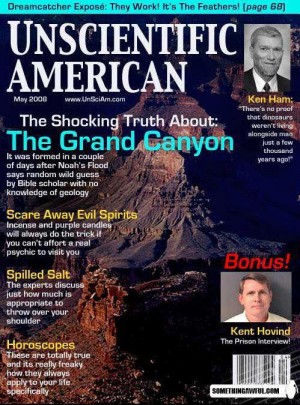
For those of us who have spent our lives fighting the never-ending creationism wars, small victories are precious, and give us hope that some day this will all be behind us. The Dover decision in 2005 was decisive, and the Discovery Institute has been ineffective ever since then, with no further school districts adopting “intelligent design” creationism. (Of course, creationism then morphed into the “teach the controversy/strength and weaknesses” strategy, which passed in Louisiana, Tennessee, and Kentucky). The clowns like Don McLeroy on the Texas State Board of Education who voted for all sorts of laws favoring creationism and other fundie distortions of science have been voted out of office, although not all their damage has been undone. The fundies in the Kansas State Board of Education were also voted out of office after they had embarrassed the good taxpayers of the Sunflower State enough times.
Likewise, every time another powerful creationist institution or preacher stumbles or declines, it gives us a bit of schadenfreude (“joy at the misfortune of others” auf Deutsch). A few years ago, the Institute of “Creation Research” seemed to be a powerful behemoth, which had a leading role in all the creationism battles of the 1970s, 1980s, and 1990s. But as I discovered when I visited their former headquarters in the suburbs of San Diego, they left their pathetic little “museum” behind (see this post), sold to a Jewish convert to radical Protestant fundamentalism, and relocated to Texas in 2007. Their founder, Henry Morris, died in 2006, and their master debater, Duane Gish, just passed away last week, and the ICR has fallen on hard times. Their efforts to get their master’s program accredited in their new home, fundie-friendly Texas, have failed, and they have vanished from the headlines of the creationism wars after having dominated for years. Many of the “big guns” of ICR have since moved on to other institutions, such as little Cedarville University in Ohio, where they engage in stealth creationism in geology meetings. Continue reading…
comments (31)
by
Donald Prothero, Jan 09 2013

A few weeks ago I wrote a post about how creationist “baramin” taxonomy was an example of amateurs aping what scientists do without actually understanding the science, all couched in the trappings of real science and in “sciencey”-sounding language. Almost as soon as that post came out, another example came to light that was noted by bloggers on Panda’s Thumb and Pharyngula and elsewhere. It starts with a silly video (complete with fancy production values and dramatic opening music) featuring ID creation “scientist” Ann Gauger, talking in front of what looks like a conventional biochemistry lab.
As Larry Moran, Ars Technica, and numerous commenters over at Panda’s Thumb pointed out, her discussion is complete gibberish that shows she had no understanding of evolution or genetics. She talks about “population genetics” and “common descent” as if they had something to do with one another. Even a second-year biology undergraduate knows the difference! Population genetics is the field that simulates the changes in gene frequencies through time in natural populations, with models of how changing selection pressures, mutation rates, etc. might affect gene frequencies over time. It is largely a mathematical modeling exercise, although its predictions have been abundantly tested and corroborated by many lab experiments. Population genetics is only a population-level process. It says nothing about the common ancestry of organisms, or their similarity in gene sequences, which is what Ann Gauger seems to think. Apparently, Gauger doesn’t know the difference between population genetics and phylogenetics, the field that does deal with the evidence of common ancestry. What the heck, if it begins with a “p” and ends with “genetics”, it must be the same thing, right? Continue reading…
comments (21)
by
Donald Prothero, Dec 12 2012
One of the strangest aspects of “creation science” is their attempt to reconcile the fact that there are between 5-15 million species on earth, yet somehow they all had to fit on Noah’s ark (one pair or seven pairs of them, depending upon which version of the story you read). Such an idea might have made sense to the ancient Hebrews, who only knew of a few dozen kinds of larger mammals in the ancient Middle East, and did not make distinctions between most types of insects or other invertebrates (just as most people today call almost all insects, arachnids, and other small land arthropods “bugs”), let alone recognize the existence of microorganisms. But the modern-day “creation scientist” must be a strict literalist, and cannot take these ancient stories in the context of their times. Instead, these myths must be literally true in today’s context, and then whatever modern science has revealed in the past few centuries must be re-interpreted or discredited or ignored. It’s one of the most astounding examples of motivated reasoning, reduction of cognitive dissonance, cherry-picking, and confirmation bias one could imagine. In the case of shoehorning all of life into tiny Noah’s ark, they even have invented a name for it (“baraminology”). Quite a few creationists play at this pointless game of sophistry, arguing how many angels could dance on the head of a pin. Continue reading…
comments (21)
by
Donald Prothero, Nov 28 2012
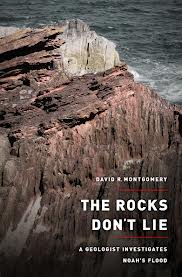 A review of The Rocks Don’t Lie: A Geologist Investigates Noah’s Flood, by David R. Montgomery
Creationists are notorious for distorting or denying the facts of biology (evolution), paleontology (denying the evidence of evolution in fossils), physics and astronomy (denying modern cosmology), and many other fields. But some of their most egregious attempts to twist reality to fit their bizarre views are found in “flood geology,” a concoction of strange ideas about the geologic record that clearly demonstrate how little actual experience any of them has in looking at real rocks. I dissected this issue in great detail in Chapter 3 of my 2007 book, Evolution: What the Fossils Say and Why it Matters (Columbia University Press, New York).
David Montgomery, however, devotes an entire book to the topic of geology and creationism. The title is tantalizing, making one wonder whether this is yet another creationist book disguised as real science. But the content is relatively straightforward. Montgomery is a well-respected geomorphologist at the University of Washington who has studied landforms around the world, and he makes it clear up front that he is not about to support the ridiculous ideas of flood geology. Instead, he embarks on a long narration that is part travelogue, part history, and part description of the breakthroughs in biblical scholarship that long ago led to the rejection of biblical literalism by anyone who can actually read the Bible in the original Greek and Hebrew. Continue reading…
comments (4)
by
Donald Prothero, Oct 24 2012
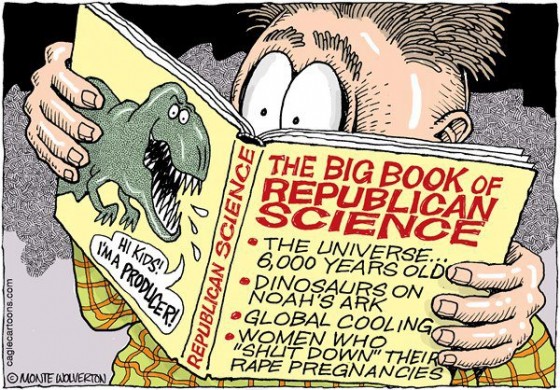
The news recently has been full of shocking and disconcerting quotes from the members of Congress. The most outrageous is by Rep. Paul Broun of Georgia (an M.D., even!), who said (in a recent speech at the Liberty Baptist Church Sportsman’s Banquet):
“God’s word is true. I’ve come to understand that. All that stuff I was taught about evolution, embryology, Big Bang theory, all that is lies straight from the pit of hell. It’s lies to try to keep me and all the folks who are taught that from understanding that they need a savior. There’s a lot of scientific data that I found out as a scientist [note: Broun is NOT a real scientist] that actually show that this is really a young Earth. I believe that the Earth is about 9,000 years old. I believe that it was created in six days as we know them. That’s what the Bible says. And what I’ve come to learn is that it’s the manufacturer’s handbook, is what I call it. It teaches us how to run our lives individually. How to run our families, how to run our churches. But it teaches us how to run all our public policy and everything in society. And that’s the reason, as your congressman, I hold the Holy Bible as being the major directions to me of how I vote in Washington, D.C., and I’ll continue to do that.”
When he heard this statement, Bill Nye said:
“Since the economic future of the United States depends on our tradition of technological innovation, Representative Broun’s views are not in the national interest,” Nye told The Huffington Post in an email. “For example, the Earth is simply not 9,000 years old,” he continued, contradicting a remark made by Broun later in the video. “He is, by any measure, unqualified to make decisions about science, space, and technology.”
Continue reading…
comments (55)