Skepticblog
About Daniel Loxton

Daniel Loxton is the Editor of Junior Skeptic (the 10-page kids’ science section bound within Skeptic magazine). He is the author and illustrator of the national award-winning kids’ science book Evolution: How We And All Living Things Came to Be (translated into Slovenian, Korean, Norwegian, and, in a modified form as the separate book Evolução, Portuguese). Evolution won the 2010 Lane Anderson Award recognizing the best Canadian science book for young readers. It has also been named a finalist for the Norma Fleck Award (recognizing the best Canadian nonfiction book for young readers) and the Ontario Library Association’s prestigious Silver Birch Award. Daniel is also the author and illustrator (with Jim W. W. Smith) of Ankylosaur Attack, a paleofiction storybook for ages four and up. This is the first book in the “Tales of Prehistoric Life” series from Kids Can Press. Daniel has written for critical thinking publications including Skeptic, Skeptical Briefs, eSkeptic and the Skeptical Inquirer, and contributed cover art to Skeptic, Yes mag, and Free Inquiry. In a previous career, Daniel was a silvicultural shepherd for ten years (working mostly along the BC side of the Alaska panhandle).
RSS feed for this author
www.skeptic.com/junior_skeptic
Junior Skeptic Facebook page
Subjects
aliens alternative medicine atheism autism belief bigfoot Brian Dunning CAM Carl Sagan climate change conspiracy theories Creation creationism critical thinking cryptozoology denialism dinosaurs Dr. Kiki earthquakes economics education environment ethics evolution fossils geology Ghost Hunting ghosts global warming God homeopathy intelligent design james randi journalism media medicine michael shermer morality nasa paleontology paranormal politics pseudoscience Psychics psychology religion science science denialism scope SETI Shermer skeptical history skepticism skeptoid Skeptologists TV ufo ufos vaccines videoRecent Comments
- Daniel Loxton commented on A Fond Farewell to Skepticblog at 1:25 pm, September 18, 2014
- markx commented on A Fond Farewell to Skepticblog at 8:52 pm, September 17, 2014
- Thomas commented on False Equivalence at 11:44 am, September 15, 2014
- John Greg commented on A Fond Farewell to Skepticblog at 2:10 pm, September 13, 2014
- tmac57 commented on A Fond Farewell to Skepticblog at 10:39 am, September 13, 2014
Read posts by author:
New NCSE Executive Director Ann Reid

Ann Reid. Photo by Chris Condayan, asm.org. Courtesy NCSE
Our colleagues at the National Center for Science Education have welcomed their brand new Executive Director Ann Reid, who began her new job yesterday (January 6, 2014). A molecular biologist, Reid is the successor to outgoing executive director Eugenie C. Scott, who held the post for an astonishing 27 years. On her retirement, Scott became the Chair of NCSE’s Advisory Council.
With its mission to defend the teaching of evolution and climate science, the NCSE is among the most essential organizations to operate within the general sphere of scientific skepticism. It is also a shining example of the power of constrained focus. I happen to know, for example, that Genie is a fellow “Bigfoot skeptic”: she is not only the Chair of the venerable Bay Area Skeptics, but also a physical anthropologist with a specific interest in pseudoscience related to her field—which is to say, Bigfoot and the Yeti (video). Nonetheless, the NCSE has never tried to tackle a broad portfolio of paranormal and pseudoscientific topics. Instead, they picked a tightly focused mandate, and made themselves a credible, reliable national voice on that topic in particular. Very often, simplicity is strength. (continue reading…)
comments (1)New Organization: The Society for Science-Based Medicine
Our colleagues over at the Science-Based Medicine blog, including Skepticblog’s Steve Novella, have announced the creation of a new advocacy and educational organization, the Society for Science-Based Medicine.
The attempt to confront medical pseudoscience, examine paranormal and supernatural healing claims, and expose outright medical quackery is one of the deepest and oldest of the pillars of scientific skepticism. From homeopathy to psychic surgery, such claims will always remain priorities for skepticism, and for skeptical organizations such as the one I represent, the Skeptics Society. Indeed, I write on medical claims myself, such as in this article or this for our own free eSkeptic newsletter.
But focus is a powerful thing. Just as I frequently advocate disentangling the unique mandate of scientific skepticism from atheism and other parallel rationalist movements, so too is there a clear value in having dedicated, full-time science-based advocacy organizations that discuss medicine and only medicine. The topic is certainly large enough (large enough, indeed, for hundreds of organizations worldwide) complex enough, and sufficiently pressing in ethical urgency to deserve dedicated watchdog efforts. (continue reading…)
comments (4)Bright Horizons
Happy New Year, folks! I’m settling back into work having celebrated an epic holiday season with my family, and feeling a bit like I’m going to explode. The music is on loud in here. I’m rested and happy, looking back over a fascinating year—and looking forward to the bright horizons of the year ahead.
Do you feel it? That soaring quality in the air, that sense that this is a year we accomplish beautiful, useful things? That this is a year when we will make the world a little bit better? (continue reading…)
Comments OffThe Skeptics Society’s Distinguished Science Lecture Series: Now on Vimeo On Demand
Since 1992, the Skeptics Society has sponsored the Distinguished Science Lecture Series, hosting hundreds of the biggest names in science. This series has covered cutting edge discoveries and controversial topics, and enabled students, educators, and the general public to hear what’s new in science and skepticism.
You can learn more about our upcoming lectures at Skeptic.com. Many of our past lectures are available to purchase on DVD at Shop Skeptic. Today, we’re excited to announce another option: we’ve now made 22 of our most popular science lectures (over 33 hours!) available to RENT instantly through Vimeo on Demand!
comments (10)Sharon Hill on the Unsettling Truth About Everything You Think You Remember
Doubtful News editor and fellow cryptozoology critic Sharon Hill has a new post up at her Huffington Post: Weird News column on the topic of the fallibility of memory—and on the very serious implications of that fallibility upon eyewitness testimony, whether of Bigfoot, Satantic Ritual Abuse, or regular everyday crime. Most everyone who follows the skeptical literature (or of course the psychological literature) is to some degree aware that memory is fluid, dynamic, creative stuff by its nature. (I’ve written about the fluidity and impermanence of memory myself.)
Yet knowing that memory is constructed is different from knowing it as a visceral fact about our personal experience of reality. Like the knowledge of death, it’s a dizzying truth that we use in rhetoric, yet shrink away from in our inner minds: none of our memories are entirely real. They’re all simulations, “based on a true story” recreations—except for those that are altogether fictional. Our childhood home. The kiss of our first love. That epic, life-changing adventure we know we will never forget. Our cries of despair. The joy of a wedding, a discovery, a birth. Moments of grief. Moments of hope. The truth is that all of our past experiences are gone, never to be savored again.
We humans are storytelling animals. This extent of this storytelling goes deeper than we can easily hold in our minds. Our very existential continuity is a story we tell ourselves.
comments (4)Loxton Speech at CFI Summit 2013
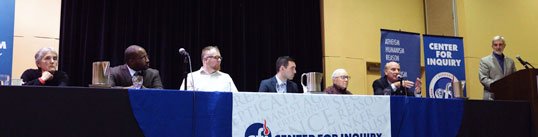 I recently had the pleasure of representing the Skeptics Society as a guest of the CFI Summit conference in Tacoma, Washington, hosted jointly by the Center for Inquiry, the Committee for Skeptical Inquiry, and the Council for Secular Humanism. I was invited to contribute a 20-minute talk as part of the October 25, 2013 opening panel on the topic “Humanism and Skepticism: Separate or Joint Agendas?” with Ron Lindsay, Barry Kosmin, Ophelia Benson, Mark Hatcher, Ray Hyman, and Michael De Dora. Most of the panel argued that these two traditions either overlap very extensively, or can be usefully packaged together. As expected, Ray Hyman and I were the exceptions.
As a frequent critic of conflation between skepticism and parallel rationalist movements, I was asked to revisit some of my arguments regarding skepticism’s distinctiveness. Regular readers will recognize that the central portion of my speech was adapted from my two-chapter historical exploration “Why Is There a Skeptical Movement?” (PDF)—notably from a section which I have previously posted as a standalone blog post. Nonetheless, there is also much here which I have not said publicly in the past.
I present my remarks here essentially as they were delivered:
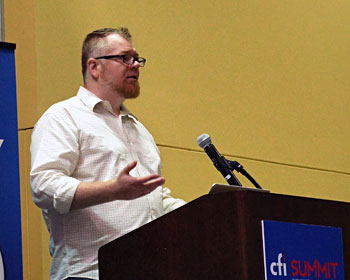
Daniel Loxton delivers his talk at the CFI Summit 2013 conference in Tacoma. Both this image and the panel photograph at the top of the page are by Brian D. Engler (used with permission)
I’d like to thank the folks here at the Center for Inquiry for inviting me to join you here today.
I work for Pat Linse and Michael Shermer over at the Skeptics Society, so in some sense I’m an outsider here. And yet I feel intimately connected to the history and work and people—connected to both of the distinct traditions—that are represented at this event.
Comments OffAnnual Sale at Shop Skeptic
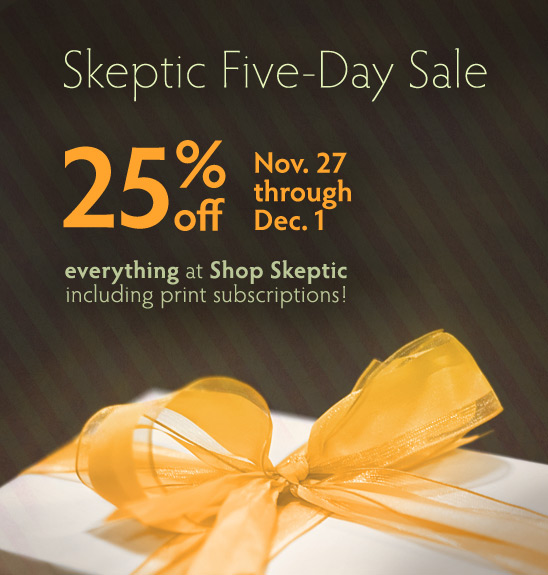
Now through Sunday 25% off everything at Shop Skeptic
It’s our best sale of the year, on now through Sunday, December 1.
Save 25% off everything at Shop Skeptic: books (including my own books for children and adults), DVDs, print subscriptions to Skeptic magazine (which include my own Junior Skeptic stories), hoodies, t-shirts (and other cool swag), as well as printed back issues of Skeptic magazine.
Comments OffSupport Our Work at the Skeptics Society
Howdy, folks!
We’ve just released our annual appeal for your support of our work at the nonprofit Skeptics Society. For over 20 years the Skeptics Society has been at the forefront of skepticism’s efforts to study the paranormal and fringe science, curb their dangerous excesses, and provide the public with reliable science-based information about those controversial topics.
 To learn more about our work, or to learn how to help solve mysteries with a tax-deductible donation, please check out today’s eSkeptic newsletter.
I’d like add a personal note to our organizational appeal. Your support gives the Skeptics Society the resources and inspiration to undertake deep, reflective, useful work across many media. Among those diverse public service projects, one educational effort I am especially proud of and involved in is the Junior Skeptic magazine-within-a-magazine bound inside Skeptic. It’s a rare privilege, as a skeptical researcher and activist, to be able to dig down into paranormal mysteries in a serious, in-depth way—and rarer still to have the time to find ways to distill that research for a young audience.
I know that some of you enjoyed my first book for young readers, Evolution: How We and All Living Things Came to Be, or my recent book with Don Prothero for general readers, Abominable Science! Neither of those projects would exist without the Skeptics Society and the donors who support it. Evolution is a direct adaptation from material created first for Junior Skeptic. Abominable Science! is built upon years of research for various issues of Junior Skeptic. The Skeptics Society is one of the few institutions in the world pursuing research on paranormal topics. Junior Skeptic remains the skeptical movement’s most sustained and substantial outreach project for children. I’m grateful to everyone who lends their support to that work.
Similarly, I’d ask those who enjoy Skepticblog to consider a donation in support of the Skeptics Society. Skepticblog was built by the Skeptics Society, and is maintained at our expense by Skeptic.com Webmaster William Bull. As well, my own posts in particular are made possible with the Skeptics Society’s encouragement, and are built again upon the research that our donors and subscribers make possible.
Thank you to all of you for reading, recommending, and championing our work at Skepticblog, Skeptic magazine, and the Skeptics Society—and thank you for all the thousands of other ways that thousands of individual skeptics have found to share the beauty of scientific understanding.
—Daniel
Comments OffFarewell to Pyramid Power Promoter Max Toth
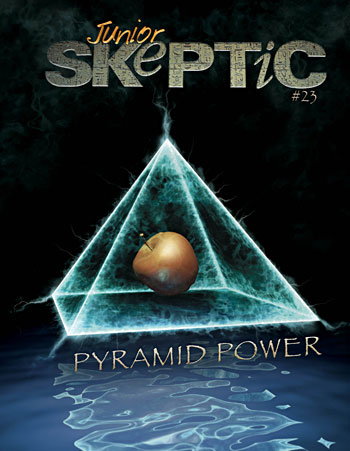
Junior Skeptic 23, bound inside Skeptic Vol. 12, No. 2
In an upbeat moment the other day, I tried proposing on Twitter that we might take a moment to try naming some things we like, respect, or even admire about a person, movement, organization, or subject area over on the paranormal / fringe science advocacy end of things. I offered up a few examples of my own. One of the first to come to mind was a conversation I had with 1970s “pyramid power” promoter and bestselling author Max Toth.
I spoke with Toth while I was working on my Junior Skeptic story on pyramid power back in 2005 (Junior Skeptic 23, bound inside Skeptic Vol. 12, No. 2) and found him an unusually friendly and generous source. Toth was happy to share his experiences and insights into a once flourishing for-profit paranormal business—the kind of information available only from insiders, and only if they are willing to share. Toth was entirely willing to share his recollections openly, despite the fact that he claimed to have “no doubts, none whatsoever” regarding the alleged paranormal powers of the cardboard pyramids he manufactured—and despite the fact that he knew I would critique that belief in my article.
comments (7)
Have you heard that Bigfooters finally have the proof we’ve been waiting for? At long last, after half a century of hunting, they have finally gotten their hands on a really seriously genuine Bigfoot body—again! And by astonishing coincidence, this totally completely real Bigfoot body is being offered up to the media by one of the exact same guys who gave us the previous totally real “Georgia Bigfoot” body, way back in the storied yesteryear of 2008. That case was a hoax. As the hoaxers explained, the 2008 “body” was really a costume stuffed with roadkill.
Now that same hoaxer is now back, making headlines with the claim that he shot and killed another Bigfoot. “I’m going to go down in history as the best Bigfoot tracker in the world,” he boasts —and for some reason we’re talking about it.
Make no mistake, there is a disreputable basement level to Bigfootery, and this is it. I said as much when my Abominable Science! co-author Don Prothero wrote to me a couple of days ago to ask if we should put up a post about it. “It’s really the lowest end of Bigfoot beeswax,” I replied. “I kinda hate to publicize it. I don’t think I’ll bother writing it up at this point.”
Thing is, I’m fond of cryptozoology. I’m really only interested in dealing with the better cases and the more serious practitioners. I think cryptozoologists are mistaken, but that does not mean that I want cryptozoology presented as a complete circus. To that end, for example, I made a conscious choice years ago not to record and use the many interpersonal feuds and slurs that Bigfooters hurl at each other, even though they’ve cooked up some real humdingers. It’s not my job to make monster-hunters appear ridiculous, but to attempt in good faith to find out what’s true. (continue reading…)
comments (5)